

On the brink of revolution, the French society of the 1780s was anything but united. At the broadest level, people have spoken about three distinct groups: the nobility, the clergy, and the Third Estate.
The Third Estate
Roughly 23 million out of the 28 million inhabitants of France are lumped into the label of “Third Estate,” despite having numerous subgroups, cultures, and conflicting interests among themselves. Each group would come to play their own roles in the revolution to come, and each person had their own reasons to do so and unique visions for what was to be accomplished. So, who were these people, and what were their lives like in years leading up to the collapse of the French monarchy?
The Peasantry
The largest category within this distinction would be the peasantry. Among the peasants, we would see farmers who cultivated their land and sharecroppers in the poorest regions who would divide their produced crops between tenants and workers. Poorer peasants were often forced to seek additional incomes beyond their farm work, either working in rural industries or finding part-time work as seasonal laborers.
Despite the terrible conditions of the sharecroppers at the bottom, not all peasants were so destitute. For some who owned their land, their crops could sustainably feed their families while also generating additional income from rising prices. Here, we can already see the issues that can arise from trying to sort 28 million people into just three categories. In just one of those groups, the Third Estate, we can already find poor peasants and prosperous peasants who live vastly different lives.
Their individual differences could be overlooked, however, through one issue that afflicted the lives every peasant: taxes. These taxes even came from multiple sources, all demanding different prices on various activities or business. The taille was owed to the state, the dîme was owed to the Church, and seigniorial dues were owed to one’s lord. Furthermore, the legal rights of the upper classes were routinely used to extract ransoms from all areas of a peasant’s life. Rights over animals used for ploughing, ferries for crossing rivers, goods and stalls at markets, policing for roads, fishing in rivers, wells for extracting water, the ability to keep ferrets as pets, grain for feeding pigeons, fires and chimneys for heating, space to build houses, and a general ban on hunting for everyone outside of the nobility.
While taxes were theoretically supposed to do something to serve the people of France, peasants were still living in precarious conditions. Widespread hunger arose as a result of bad harvests out of their control. The youngest members of the peasantry were often hit the hardest: infant mortality rates were rising and children who were lucky enough to live past infanthood grew up treating shoes and clothing as luxuries.
The Artisans
In the leadup to the revolution, manufacturing was primarily based in larger cities. In May of 1776, the system of corporations in Paris was reformed away from the historical hierarchies of masters, journeymen, and apprentices. Now, all that was required to become the master of a corporation was to pay a set of taxes. This opened new opportunities for women and foreigners who were previously restricted from joining this system.
While the surface-level arrangements might have implied an expanding level of freedom for this class of workers, that expansion of opportunity was accompanied with an increase in surveillance and control capabilities from their bosses and the state. Corporations were concentrated into an increasingly small number of powerful firms, with the total number of them allowed in Paris going from around 100 down to 44 in a short span of time. The lives of laborers were intensively scrutinized, preventing them from organizing in groups, requiring them to enroll in registers controlled by their masters, and only allowing them to leave their employers with a written approval. Lenoir, a lieutenant-general of police sent roaming squads around in the night to crack down on unapproved work and the unemployed. Anyone without official papers or employment were rounded up and arrested.
Social relations between the workers and their masters began to break down. Younger workers who previously would have raised their hats in respect when their master walked into the room no longer did so. Deprived of their rights of movement and choice between corporations, they didn’t see a reason to continue on with the one-way display of respect. Instead, they began to treat their masters coldly, glaring and snickering at them behind their backs. Workers also began to assert their independence in smaller ways: working slowly, taking smoke breaks, and delaying orders as they pleased.
Solidarity between workers also put them in direct conflict with the existing business and policing institutions. As an example, we can look at the case of Durant and Hurlot, two stone-cutters who lived in Paris. Paris police archives described an incident that began at six in the evening on May 2nd, 1785:
“Florentin, sergeant of the guard at Vaugirard, having been called by monsieur Dupont, wine-seller, regarding a number of individuals who were drinking at his establishment and had caused damage, breaking earthenware jars and unwilling to pay for these or even the wine they had drunk, we proceeded there and most of those involved had escaped with the exception of Durant, a stone-cutter, who was arrested along with Hurlot, also a cutter. When we set off, some sixty other stonecutters ran behind us and attacked us to free the two arrested men, I ordered bayonets fitted and they, seeing that they could not approach any closer, took up stones and cobbles from the street and threw them at us, a certain Gateblie, a member of my squad, was struck in the legs, in the belly kidneys and in the face, and is dangerously wounded.”
The sergeant called out the Vaugirard guard to assist him, which allowed him to arrest Durant and Hurlot along with one of their sixty stonecutter defenders. The re-arresting of those three stonecutters triggered a second ambush, where the workers came back to free their allies once more. The sergeant was forced to call in the support of the military to bring the three into the nearest prison. It took the combined power of the sergeant, his bayonet-armed police squadron, two military infantry sections, and full cavalry brigade just to arrest three poor stonecutters.
The Financiers
The later half of the 18th century saw Paris grow into a sprawling, urban center of trade. The expansion of the city brought the population up over six hundred thousand people, making Paris the most populous city in Europe behind London. In Paris’ wake, other cities throughout France also began their processes of rapid growth and urbanization. Lyon, Bordeaux, and Marseille all passed the one hundred thousand population marker in the leadup to the revolution.
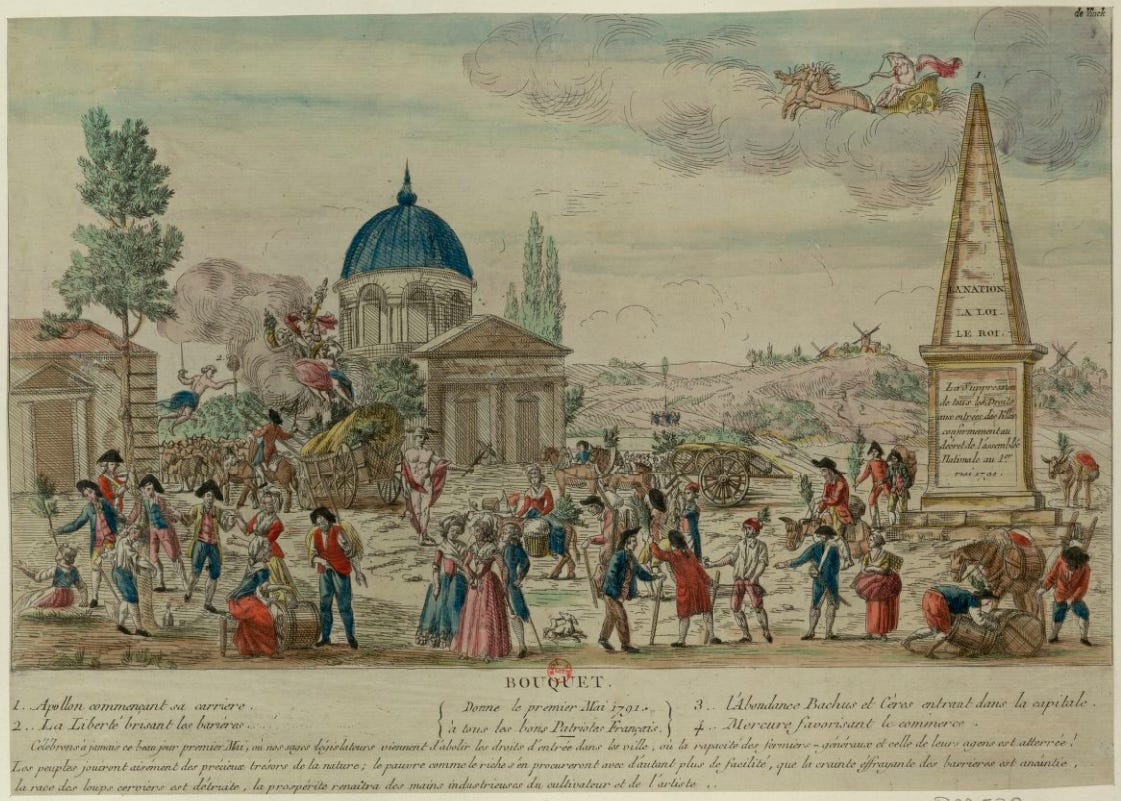
One of the consequences of this widespread urban growth was the creation of new financial systems and networks. A new class of financiers took the form of the fermiers généraux (farmers general): those who were responsible for collecting taxes for the state and overseeing the customs duties on all goods and commodities that entered the city. In 1785, the power of this new class was put on display as fifty-five barriers were built into a new wall surrounding Paris. The forty members of Ferme-Générale had upwards of 25,000 employees to enforce the taxes and contraband regulations. Furthermore, the members had the right to act in the name of the king, meaning they could send smugglers to be executed at the galleys or the gibbet.
The growth of banking and stock-exchanges also played a prevalent role in this period, with the fermiers généraux frequently found themselves in the company of bankers, stock traders, and arms suppliers. The members of the Ferme-Générale would use this position of power to grow wealthy as the city grew larger. While not officially classified as nobility, their close connections to nobility would later make them prime targets for the guillotine.
The Intellectuals
Some of the most well-known figures of the revolution emerge from this small group. While still considered to be a part of the vast Third Estate, the professionals and intellectuals often had more resources and education compared to the poorer peasantry. This left them in a position where their personal interests aligned with the revolution, while their financial privileges gave them the ability to broadcast their ideas to the public.
Lawyers were prominent members of this group, but other professions such as magistrates, notaries, and professors often played similar roles. Writers, journalists, and publicists also played a key role in the power of this class.
The intellectual parts of the revolution can find their roots in the philosophical and political readings that were being spread around throughout the professionals of the time. A common language could be found in the writings of the Enlightenment — a western-European philosophical tradition built around ideas of reason, liberty, and humanity. A major part of Enlightenment philosophy is the political philosophy of the social contract, a concept in which states derive their legitimacy from an agreement of rights and duties between rulers and the ruled. Writers like Locke, Hobbes, Bentham, Rousseau, and Paine can be found among the wide library of the Enlightenment, and their texts were the ideological grounds upon which the revolution would justify itself against the existing monarchy.
Grounds for Revolution
The Ancients and the Americans
Alongside philosophical ideas, new concepts and understandings of history began to take root among the people of France. One notable example was the excavations of the ancient cities of Herculaneum and Pompeii. Starting in 1738, the public slowly began to hear stories of the characters and legends that had previously been completely unknown to the vast majority of people. Engravings from the cities were published in newspapers, giving some words of the ancients a new voice among the French. The ruins of Pompeii even gave faces to the people of the ancient days, turning the previously hypothetical people buried among the ruins into physical displays of the lives they lived. Men, women, children, and pets were found in households, while the names of heroes and writers of the time would be revived in the political speeches of the upcoming revolution.
While the voices of the ancient Romans spread throughout the minds of the French people, other voices came from across the Atlantic Ocean. Benjamin Franklin, one of the most well-known of those who signed the Declaration of Independence, was appointed as the first official United States ambassador to France in 1776, and then appointed to return there for a second period from 1779-1785. His prestige as a scientist and American founding father instantly turned him into a star among the aristocratic and philosophical circles of France. Benjamin Franklin was succeeded at the United States embassy in France by Thomas Jefferson, known at the time for his role as principal author of the American constitution.
The influence of the Americans wasn’t just limited to the upper classes — Benjamin Franklin had the American constitution translated into French and printed in bulk to be distributed throughout all of Paris. Despite that, the Declaration of Independence wasn’t authorized by the French state. Franklin, wanting to spread the words of this text too, secretly had the declaration translated into French and distributed around France. The preamble of this translated text resonated against the background of the absolute monarchy that ruled over the French People:
We hold these truths to be self-evident, that all men are created equal, that they are endowed by their Creator with certain inalienable Rights, that among these are Life, Liberty and the pursuit of Happiness. That to secure these rights, Governments are instituted among Men, deriving their just power from the consent of the governed. That whenever any Form of Government becomes destructive of these ends, it is the Right of the People to alter or to abolish it, and to institute new Government, laying its foundation on such principles and organizing its powers in such form, as to them shall seem most likely to effect their Safety and Happiness.
Economic Struggles
In 1770, right after the end of Louis XV’s reign as king, the nation found itself faced with a crisis; the costs of the Seven Years’ War were piling up while financial growth was stagnating.
We often take it for granted that governments have some amount of money to spend, and that there are collective decision makers that create some kind of budget to follow. This wasn’t the case in France prior to the revolution.
Rather than committees, public comments, community input, or even soviet central planning groups, the financial system here was relatively simple: the king spends however much he wants on whatever he wants. After the king made a financial decision, the role of the bureaucracy was to keep the receipts.
There were no fiscal years or quarterly reports either. Instead, the accounts would just overlap and conflict over time, and the controller-general would try to guess how much money was left until they went broke. No one had the ability to check how much was left in the account, so they would only get confirmation of their estimates in the event that they completely ran out of money.
Along with the lack of organization and oversight, there were also problems on the income side of the budget. The vast majority of wealth was concentrated in the hands of the elites: the senior clergy and high nobility. Despite that, there were tax exemptions for a few groups of people. Whether through explicit laws, lack of oversight, or corruption, the small group of people who paid the least amount of taxes were those who were already rich and powerful to begin with. Some localities tried to make up for this through indirect taxes, such as raising prices on goods. This led to widely varying prices across the nation. In one instance, one pound of salt could cost anywhere from half a sou to thirteen sous. This created a thriving black market of salt smugglers, which in turn led to squads of gabelous being paid to hunt down those smugglers. The smugglers who were caught were of course sentenced to execution on the galley.
Louis XVI didn’t fare much better than his predecessor. With our historical knowledge, we know that the state’s debt would triple during his fifteen-year reign as king. In the early days of his regime, however, there was clear unrest.
When the financial crisis prompted the convening of an Estates-General, in which representatives of the people would raise new taxes, the king wasn’t willing to cooperate with the procedures. The king tried to establish a new tax on registrations for newspapers and posters, and the assembly responded by rejecting this tax and deeming it illegal. The king responded by exiling every single person in the assembly to Troyes.
The public outrage in response to this abuse of power created a popular movement in solidarity with Paris. The people revolted, and the King eventually had to give up. The new tax was withdrawn.
In 1789, demonstrators faced off against the military-police force. Protestors blocked off streets, stormed city gates, and even locally imprisoned the intendants in response to repression. Some demonstrators climbed up to the rooftops of their cities in order to throw rocks, bricks, or whatever else they felt like throwing at the military. There are even multiple reports of women seizing control over church bells in order to send warning alarms to the city.
When Is It Revolution?
Despite the unease, the crises, the disorder, and all of the conflict of this point in time, there wasn’t quite a sense of “revolution” to be found in the popular understanding. Rather than some sense of a definite start, goal, and end of a specified revolution, it makes more sense to think of the revolution as something that the revolutionaries didn’t realize they were in until they were already committed.
The Enlightenment philosophers and their ideas on liberty, social contracts, democracy, and other anti-establishment viewpoints would go on to fuel the flames of the revolution. Until that point, however, the glimpses we find of the revolution can be found in the material conditions the common French people lived within, and their reactions to the worsening of those conditions. After all, peasants didn’t need to read Rousseau to realize that their landlords were exploiting them.
Thanks for reading! This is part 1 in a series on the French Revolution.
Main source: A People’s History of the French Revolution by Eric Hazan.
Looking back on some of the pivotal shifts in power and social relations in history can give us a better understand of the situation we find ourselves in today, and where we might try to go in the future. In the following posts, I hope to answer the following questions:
What reasons, if any, did people have for turning to revolution over any other methods of political change?
What caused ordinary people to support political violence, such as direct action against the state or the infamous September Massacres?
How should we think of the French Revolution today? Should we embrace the values of the revolutionaries of that era, or do we need to consider a new approach?
Very interesting read. I look forward to the rest of the series.