


The Constituent Assembly
From October 1789 until the fall of the monarchy, the upper-class possessors of French wealth put their efforts into keeping the lower classes at bay. In some instances they would do this themselves, using their wealth and connections to work their way into the most powerful offices. In others, they would use their wealth to back representatives in the political Assemblies and the Commune de Paris. Having seen the uprisings at the Bastille, the Women’s March on Versailles, and the various riots and insurrections across the rural countryside, the upper-class knew what the people were capable of.
Their main strategy, therefore, would be to manage the anger of the people so as to quietly retract their concessions over time. In their view, the Revolution was already in its ending stages. All they had to do was repress the violent outbursts.
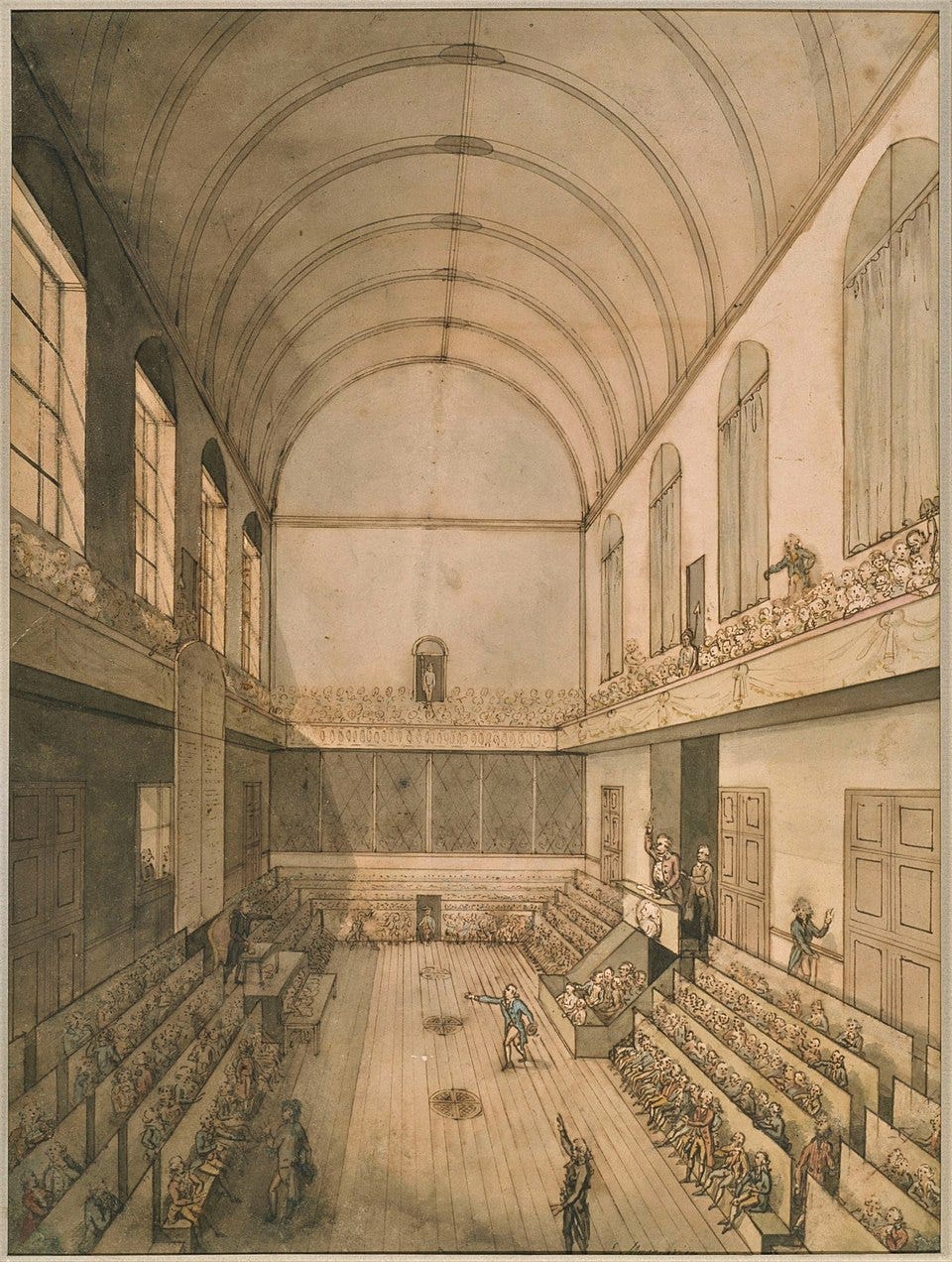
On the 19th of October, the Assembly moved the location of their meetings, following the King from Versailles to Paris. To accommodate them, new seating was constructed for the representatives alongside the Tuileries garden. These were accompanied by makeshift platforms, giving a space for the public to heckle and challenge the upcoming assemblies throughout all of their meetings. As they moved away from Versailles, the seating arrangements emerged roughly according to the spectrum of their ideologies and beliefs. As Eric Hazan puts it:
“There were no parties in the modern sense of the term, but rather tendencies and personalities.”
Whereas at Versailles they had referred to the geometry of the assembling room in terms of a ‘Palais-Royal side’ and a ‘queen’s side’, these landmarks were now missing. Instead, they referred to the seating arrangements in reference to the presidential dais at the front of the room. It was here that we got our modern conception of politics as having a left and a right. Counter-revolutionaries tended towards sitting on the right side of the room, whereas moderates sat in the middle, and the most revolutionary representatives sat on the left.
Various factions popped up among this new assembly. Sitting furthest to the right, the aristocratic noirs wore the color black in support of the queen. To the left of them, the absolute monarchists who wished to see the return of the king’s power. Next to them, the Fayettists who supported a constitutional monarchy. To their left, a large group of revolutionaries gathered around Barnave, Duport, and Alexandre de Lameth. At the furthest left corner were three outcasts: François Buzot, a lawyer from Northern France, Henri Jean-Baptiste Grégoire, an abolitionist priest, and Maximilien Robespierre, whose name would go on to become infamous throughout French society.


Social Clubs and the Democratic Press
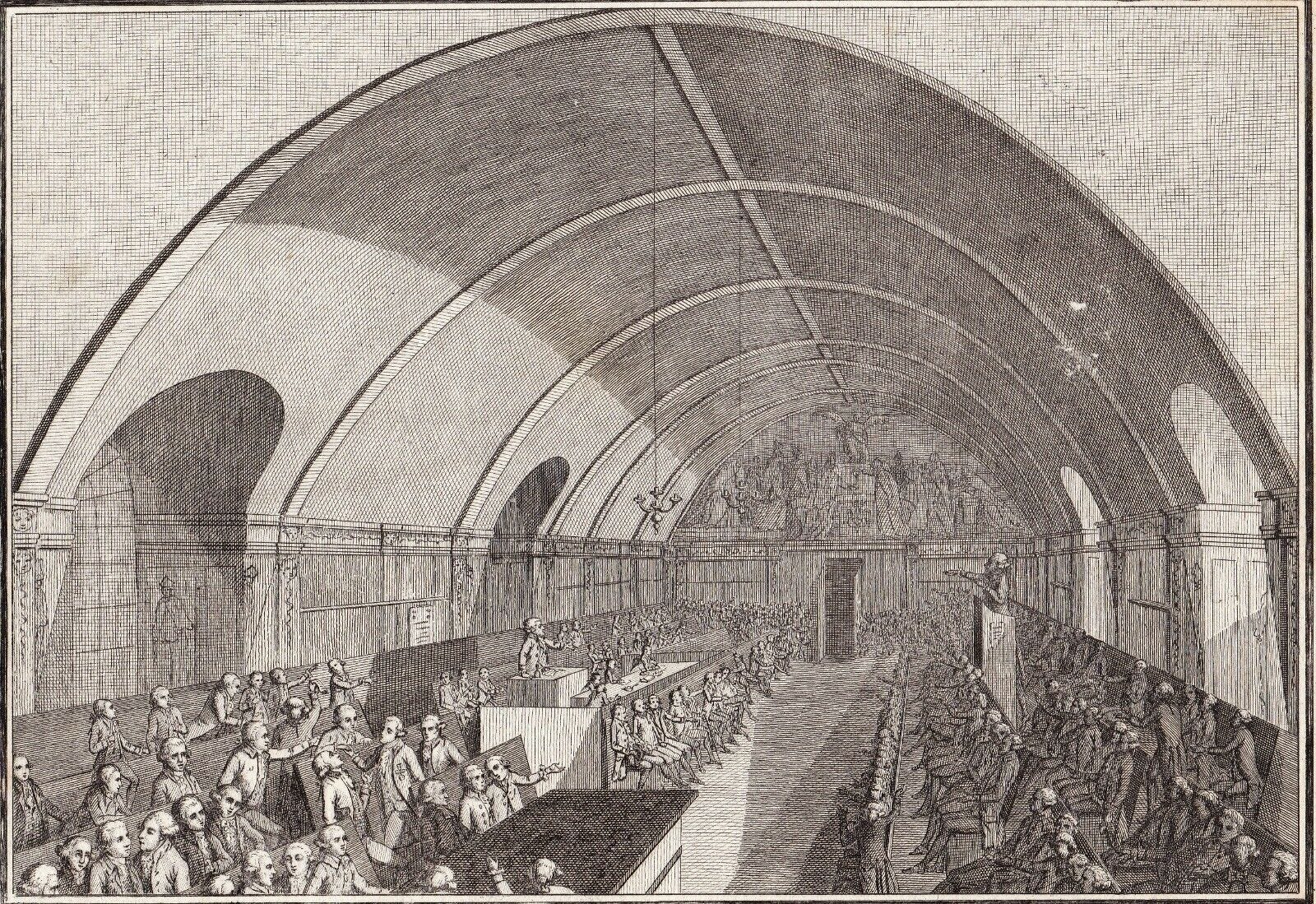
The ideas and tendencies that arose in the Assembly brought about a demand for the development of those ideas throughout Paris. Aristocratic ideas found a home at the Salon Français, and were published in papers such as Les Actes des Apôtres and L’Ami du roi. The constitutional monarchists (Fayettists) congregated at the Société de 89 at the luxurious Palais-Royal. A high entrance fee practically restricted membership to the high society, financiers, and military figures. The ideologies of those on the left wing of the assembly were primarily represented through two separate clubs: the Jacobins and the Cordeliers.
The Jacobins
The Jacobins found their start when they were looking for meeting premises that were near the new meeting place of the Constituent Assembly. They began as the “Breton Club,” meeting at a library on the Rue Saint-Honoré.
At the beginning, the members were all representatives in the Constituent Assembly, and they used the meetings to discuss whatever was going on in the assembly. As they began to expand they changed their name to the Société des Amis de la Constitution, and moved into the Couvent de l’Annonciation, a former Dominican monastery founded in 1611 by the French witch hunter and demonologist Sébastien Michaelis.
The name “Jacobin” was formerly used as a label for French members of the Dominican order, based on their origins in the Paris-based Couvent Saint-Jacques in the year 1217. Enemies of the left-wing revolutionaries began to call the members of this society “Jacobins” as an insult, wherein the revolutionaries countered by fully embracing the title. The objectives of the Jacobins were laid out in Article 1 of their rules: they would meet every day at six o’clock unless the Assembly was still in session, where they would work towards the following goals:
1. Choosing the questions that were to be decided in the Constituent Assembly
2. Working towards the establishment and strengthening of the Constitution
3. Corresponding with other related societies throughout France
While they started with the relatively modest goal of coordinating among representatives of the Assembly, they would rapidly expand by allowing entrance to anyone who was nominated by five existing members. After their membership exceeded one thousand people, they began to open their doors to the Parisian public. This led to an explosion in revolutionary thinking in Paris and inspired similar affiliated groups in other areas throughout France.
In contrast to their stereotyped image as elitist urban dictators, the Jacobins were relatively decentralized compared to other clubs and societies of the time. In August of 1790, there were 152 affiliated societies throughout the nation, and over one thousand Jacobin-affiliated societies would be formed in the years to come. This wasn’t some kind of top-down imposition of a central Jacobin doctrine. Rather, the revolutionary ideas would spread in multiple directions, both inward and outward of their center in Paris.
The Cordeliers

In 1790, another club would arise under the title Société des Amis des Droits de l’Homme et du Citoyen. These people, generally referred to as the Cordeliers, had similar revolutionary inclinations to the Jacobins while practicing a different method of exercising power. In contrast to the Jacobin strategy of developing and spreading revolutionary ideology throughout the nation, the Cordeliers focused on direct action and the struggle for justice.
Viewing themselves as the protectors of the oppressed, they would wear an emblem depicting the ‘eye of surveillance’, wide open and pointed towards the failures and misdeeds of the powerful. Some of their primary actions included making accusations against powerful wrongdoers, investigating public inquiries, visiting and legally defending imprisoned revolutionaries, and communicating with the broader public through political posters.
While you could of course find the financially well-off intellectuals that tended to join these types of clubs among the ranks of the Cordeliers, their audience was much wider than most others at the time. For example, their membership fee was only two sous per month, allowing people of the lower and working classes to join them. This led to a mix of backgrounds and skill-sets among their ranks: lawyers, journalists, and printers discussed with and fought alongside retailers, butchers, brewers, and tradespeople. The Cordeliers were also among the earliest of the social clubs to allow women to attend their session and take part in discussions.
The Cordeliers were also closely linked to the fraternal societies, a collection of local clubs in Paris. The first of these societies was the Société Fraternelle, founded by Claude Dansard, a local boarding-house keeper. Every evening, Dansard would invite the artisans and fruit and vegetable sellers in the area into a small room in the Jacobin meeting space. There, he would read and explain the latest decrees of the Constituent Assembly to them by candle light.
Similar fraternal societies popped up in every neighborhood of Paris. For example, one society in the Enfants-Rouges area accepted the attendance of any citizen regardless of status or gender, even allowing young children to attend once they were twelve years old. Through this network of clubs and societies, the often illiterate people of Paris gained valuable access to a political education.
Newspapers and Public Readings
The increasing levels of political awareness and interest among the public led to the development of the ‘democratic’ press. The printed news-sheets were relatively expensive to produce at the time, meaning that working-class people were often unable to afford a print subscription for themselves. Despite that, the news spread like wildfire through public readings and showings. In some cases, town-criers would stand in the street and yell the contents at passersby. In others, news would be posted on the walls throughout the city (even though this practice was banned by the Paris Commune). At this time, the French café served an important political role: people would meet in cafés to share newspapers with each other, read them out loud, and discuss their contents.
The contents of these papers varied widely. Moderate papers such as Le Courrier and Les Révolutions de Paris advocated in favor of the democracy and human rights while fighting against the perceived disorder of their left-wing counterparts. One paper, the Bouche de fer, was run by a Masonic institution that ran an ‘iron mouth’ system. This allowed anyone to drop off letters, notes, and messages in a dropbox which would then be printed and published.
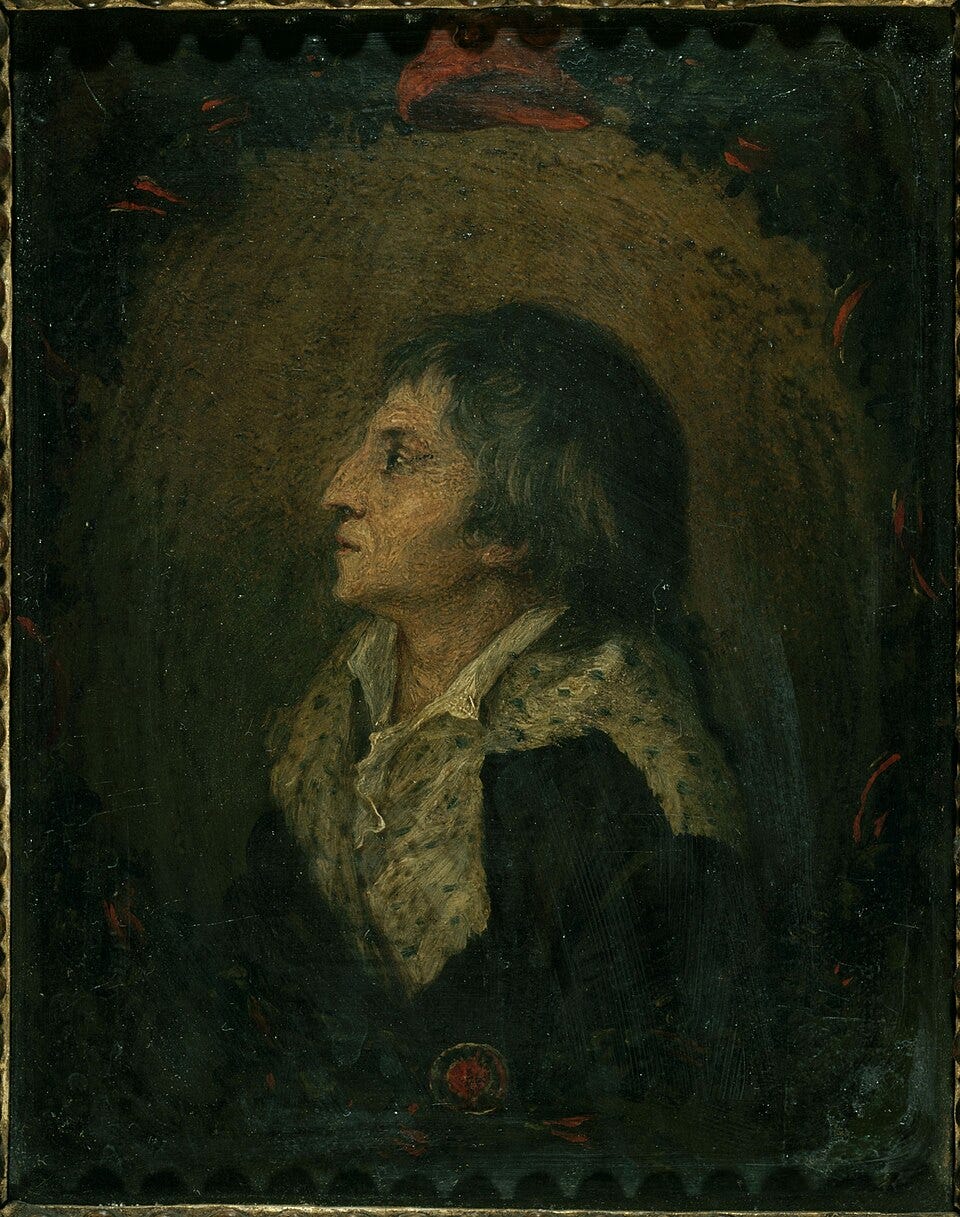
The most revolutionary side of democratic press was largely dominated by three figures: Lucie-Simplice-Camille-Benoît Desmoulins (commonly known as Camille Desmoulins), Jean-Paul Marat, and Jacques René Hébert. Each of them acted as the founders, directors, and sole writers of their papers. Each of them also acted as a journalistic enemy of the other two writers.
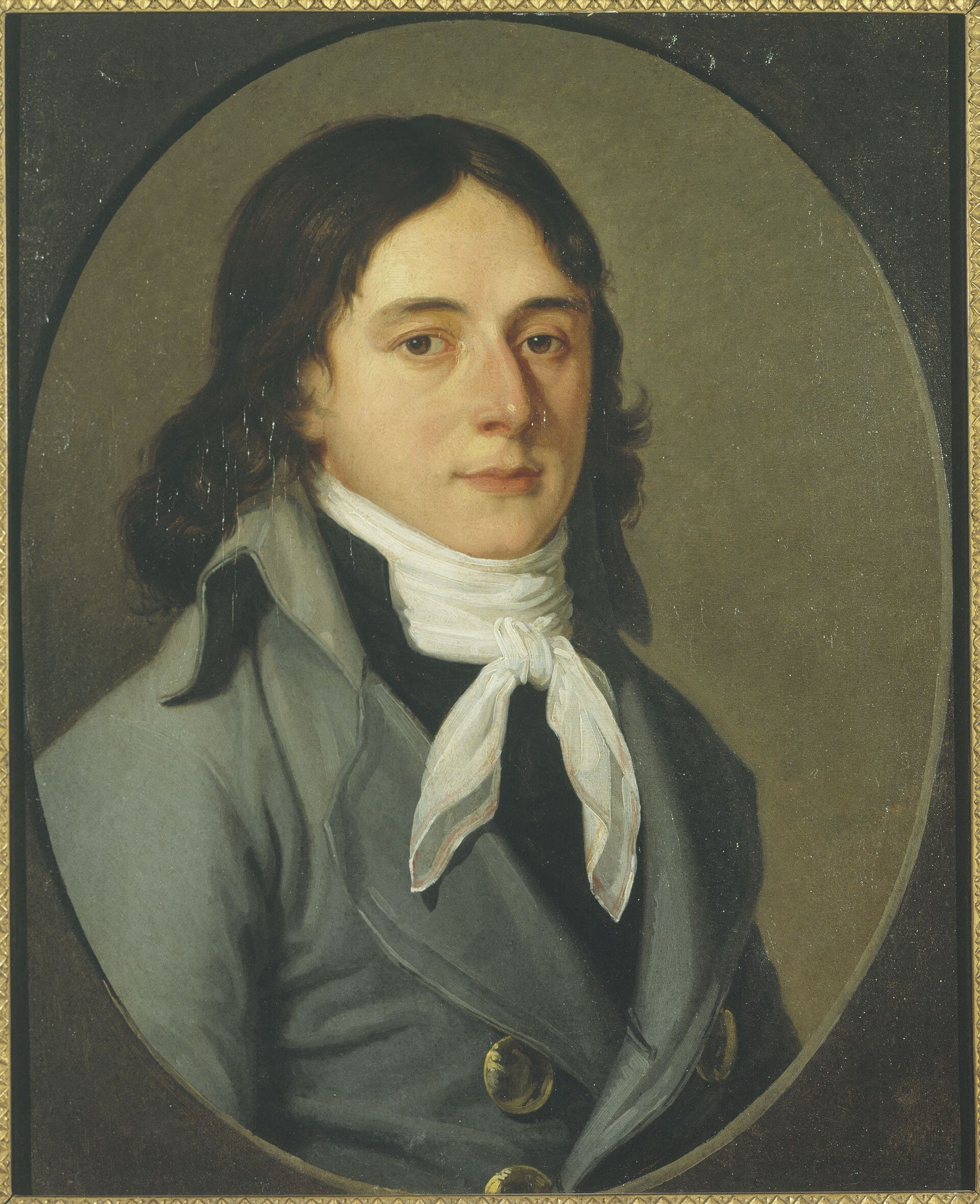

Desmoulins ran the Les Révolutions de France et de Brabant, which had three sections: France, Brabant, and Variétés. The first section addressed the French monarchy and his support for its abolition in favor of a republic. The second section addressed the Brabant Revolution, another revolution in modern-day Belgium that occurred at the same time as the French Revolution. This revolution took place in what was then known as the Austrian Netherlands in order to overthrow Emperor Joseph II and the control of the Habsburg Empire. The third section consisted of something like cultural criticism, where Desmoulins wrote reviews of books and theatre.
,_publiciste_et_homme_politique_(P725)_-_P725_-_Mus%C3%A9e_Carnavalet.jpg)
Marat started the L’Ami du peuple in September of 1789, and would go on to publish over a thousand issues under various titles. He did this despite being issued multiple arrest warrants over his years of newspaper production, and would often have to completely move his work into hiding. As the repression forced him to keep working with different printers, he was eventually forced into learning how to print the papers by himself. Each issue of the newspaper consisted of a single article, usually eight to twelve pages long. He also included letters from his readers and including them in an ongoing dialogue. Although there were a limited amounts of copies that could be printed and distributed, readers would often read them in groups as to include people who couldn’t afford or read the paper themselves.
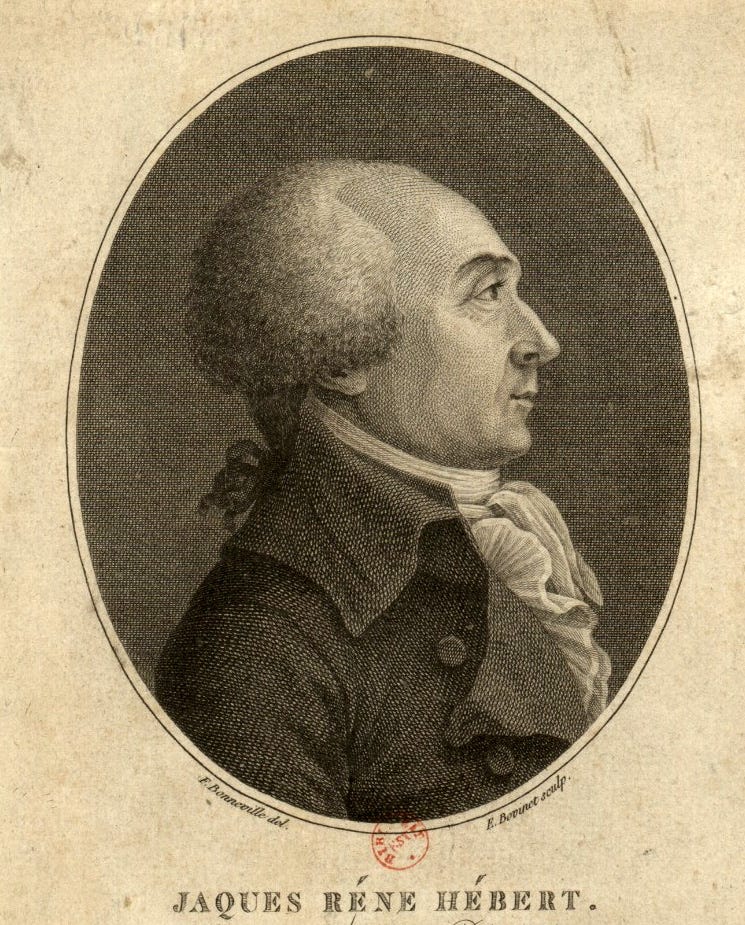

Hébert ran Le Père Duchesne, the name of a symbolic archetype of a man. The newspaper covers depicted this through an image of an angry-looking guy in a revolutionary coat and a pipe hanging out of his mouth. The paper read more like an explicit comedy or modern-day tabloid than political news, and had short summaries at the front that were meant to be cried in the streets. Other papers, books, and pamphlets would sometimes try to use the name Le Père Duchesne as a way of counterfeiting to boost their sales. It’s specific popularity among the working class sans culottes led to some upper-class people reading it in public and loudly displaying their laughter as a way to signal their virtuousness to the masses.
Martial Law
In October of 1789, riots broke out in Paris. Recent policies of free trade in grain led to shortages and hunger. At the Halle aux Farines, women resorted to looting sacks of flour from bakers’ shops. One baker named François was (likely falsely) accused of hoarding, wherein he was hanged from a lamppost, decapitated, and paraded through the streets on the tip of a pike.
The Commune of Paris (consisting of three-hundred-person council) heard about this incident, and subsequently went to the Assembly for help. There, they asked the assembly to pass a law against all gatherings in order to contain the riots.
The Assembly overwhelmingly supported the declaration of martial law. There were only two people among them that were willing to speak up against it:
Robespierre: “Those who have followed the Revolution foresaw the point you are at now; they foresaw that terrible situations would require you to demand violent measures, with the aim of destroying at one stroke both yourselves and liberty. The demand is for bread and soldiers, in other words: the people have gathered wanting bread; give us soldiers to immolate the people. You have been told that the soldiers refuse to march … Indeed! Can they attack an unhappy people whose misfortune they share?”
Mirabeau: “Everything is silence, everything has to be silenced, everything must give way faced by a hungry people; what use would martial law be, if the people gather and shout ‘There is no bread at the bakery!’ What monster would answer this with gunshots?”
Despite their protests, the Assembly drafted a decree of martial law. According to this law, the military would display red flags at the Hôtel de Ville and throughout the streets, at which point all gatherings would immediately become criminal. The punishments were harsh: unarmed protestors could expect one year in prison, armed protestors could expect three years, and leaders/instigators/violent protestors would be sentenced to death. This included the immediate execution of the man who killed the baker François earlier that day.
One of the few newspapers to critique this law was Marat’s L’Ami du peuple:
“Fools! Do you think that a piece of red cloth will protect you from the effects of popular indignation? Do you think that a few devoted satellites will defend you from the just fury of your fellow citizens?”
Thanks for reading! This is part 3 in a series on the French Revolution. The next part will cover the effects of the imposition of martial law, along with the consequences of multiple national crises.
Main source: A People’s History of the French Revolution by Eric Hazan.
Looking back on some of the pivotal shifts in power and social relations in history can give us a better understand of the situation we find ourselves in today, and where we might try to go in the future. In the following posts, I hope to answer the following questions:
What reasons, if any, did people have for turning to revolution over any other methods of political change?
What caused ordinary people to support political violence, such as direct action against the state or the infamous September Massacres?
How should we think of the French Revolution today? Should we embrace the values of the revolutionaries of that era, or do we need to consider a new approach?
Fascinating read.