


In his run for U.S. Senate, Seth Bodnar has made headlines as one of the best-performing independent candidates in the nation. Since starting his campaign, Bodnar has raised over $2.1 million. This puts him ahead of Republican Kurt Alme’s $1.1 million and well beyond Democrat Alani Bankhead’s $23,884.15. He also has endorsements and financial support from former Democratic Senators from Montana Jon Tester and Max Baucus.
The vision for an independent Montana certainly has its appeal. First, as of 2025, 45% of voters across the united states identity as independent instead of as a Democrat or Republican. In theory, this should signal some kind of broad dissatisfaction with both major political parties that would leave someone open to voting for an independent. Additionally, the existing Montana Democratic Party has increasingly made it known that they’ve largely given up on trying to win this Senate seat. This follows a long text from Jon Tester that was spread around the state earlier this year in January. According to Holly Michels with Montana Public Radio, Tester said that the Democratic Party was “poison” for his last two races. In the race he lost to Republican Tim Sheehy in 2024, he implied that the Democratic brand was (at least partially) responsible by calling it “a hell of an anvil.”
Tester further referenced some unnamed polling that showed a Democrat couldn’t possibly beat Republican Steve Daines in a re-election bid, and that a generic independent candidate would outperform a Democrat. (Although Steve Daines later chose not to seek re-election, making that polling somewhat irrelevant.) He also went on to bash Democratic candidate Reilly Neill, saying that “we can watch her talk about trans rights, democracy and bathrooms” and that “Neill will lose by 25 points, but she’s a Democrat.” (Although Alani Bankhead went on to win the Democratic nomination over Neill, making those attacks largely pointless.)
First of all, I’d challenge the former Senator to find the words ‘trans’, ‘democracy’, or ‘bathrooms’ anywhere in Reilly Neill’s platform, statements, or interviews. I personally couldn’t find any of those words on her campaign website or even any of the articles I read through on her personal blog. It’s sad to see a former Democratic Senator of mine so obviously contributing to the conservative culture war. This is a tactic we’ve seen in recent elections across the nation: you can distract everyone from talking about actual economic policies by confidently asserting that ‘Candidate X only talks about how much they love open borders and transgender people in sports’. While progressive Democrats constantly try to refocus the issues towards policy decisions that actually help working people, like universal healthcare, union jobs and collective bargaining rights, and other working class struggles with affordability, so-called ‘moderate’ Democrats are busy trying to out-conservative the Republican Party.
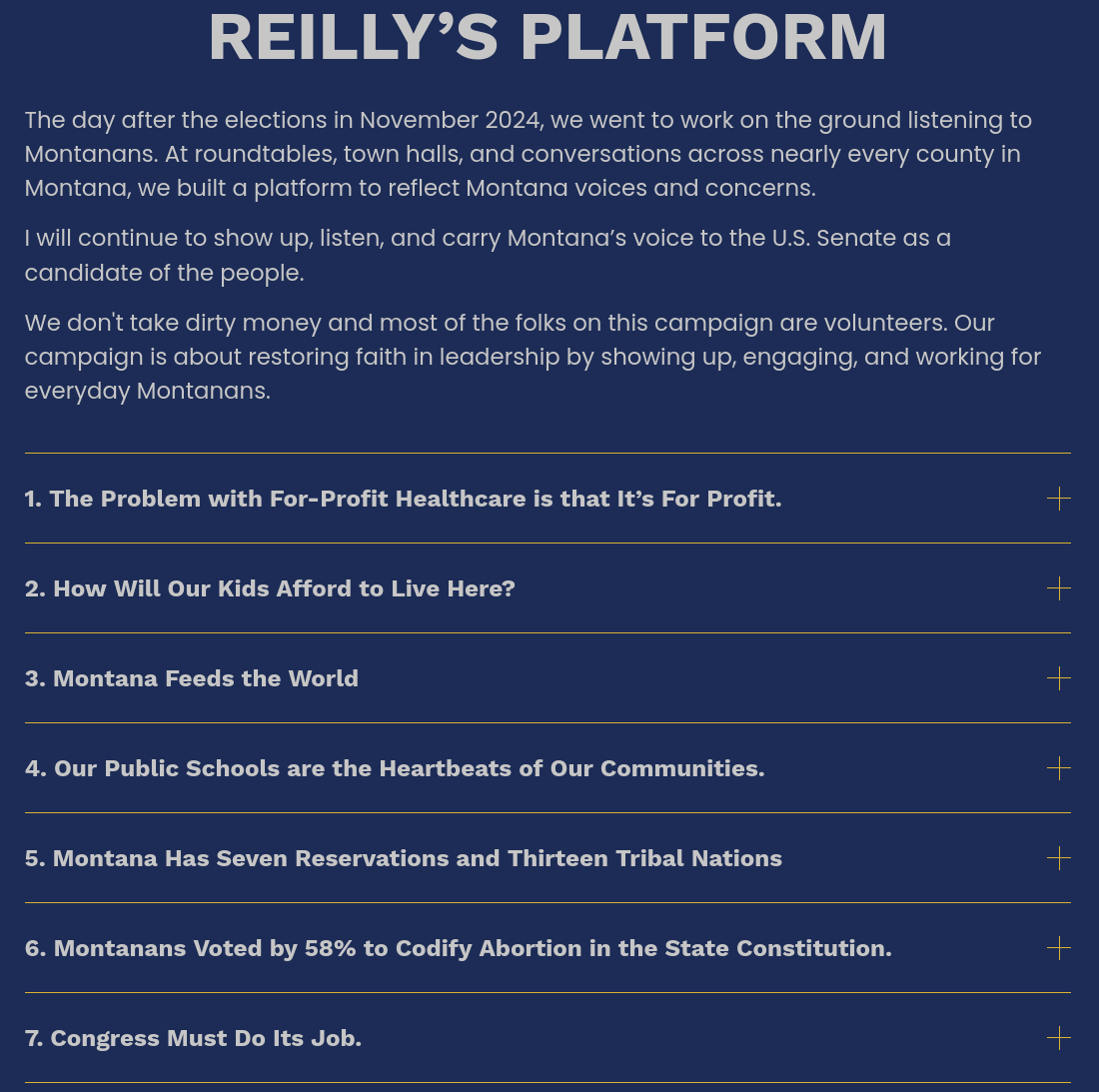
There’s also another Democratic Senator who’s taken a keen interest in this Montana race: Senate Minority Leader Chuck Schumer. This isn’t the first time that Chuck Schumer has tried this strategy: in 2024, an ‘independent’ candidate named Dan Osborn made waves in Nebraska for being seemingly being willing to resist both parties. It later came out that his campaign arose from financial backing by Schumer’s Senate Majority PAC and IMPACT leadership PAC. Dan Osborn went on to lose that race to the Republican candidate.
Chuck Schumer also endorsed Andrew Cuomo’s run for mayor in 2025 (Cuomo is primarily known for resigning as Governor of New York in 2021 following an independent investigation that found cases of sexual harassment and retaliation against at least 11 women). Schumer’s endorsement didn’t seem to help much, as Cuomo lost to Zohran Mamdani in the Democratic primary and then switched to running as an independent and lost to Zohran Mamdani again in the general election. If I was Chuck Schumer, I’d be too embarrassed to ever endorse a candidate ever again following that double-loss. Sadly, that hasn’t stopped him from giving putting his institutional support behind Seth Bodnar. Doesn’t it seem a bit weird that ActBlue, a Democratic fundraising platform, would actively allow for an ‘independent’ campaign to raise funds for a race that still has an actual Democrat in it?
Here’s another question: who’s funding this campaign in particular? Here, we can look at some of the PACs that have publicly donated to the Seth Bodnar campaign fund. At the FEC campaign finance database, we can see four PACs that have already contributed the maximum amount of $5000 for this election cycle:
Friends of Max Baucus/Max’s PAC, a principal campaign committee that was transformed into a PAC
Heartland Patriots, a Hybrid PAC (meaning it can act as both a standard PAC and a Super PAC)
Way Back PAC, another Hybrid PAC
Crosspartisan Pac I, a standard PAC that’s officially affiliated with the With Honor Fund II Super PAC
I expect this type of PAC spending to accelerate in the final months and weeks prior to election day, but we’ll have to wait to see what happens. Regardless, I think it would be wise if people dug deeper into the financial and institutional backing behind the Bodnar campaign before believing that he has some kind of unique stance against money in politics.
Shifting focus, I’d like to make a few comments on the Bodnar campaign’s general platform. Most of it is about what you’d expect: vague gesturing towards small policy tweaks for major systemic problems. I might write another post going through the platform on his website point-by-point, but for now I’d like to just highlight a few that stood out to me.
From a broad perspective, I take a lot of issue with the general approach that he takes here. In Bodnar’s view, Montana’s problems are largely caused by the corrupt Washington politicians who have stopped showing up for everyday people in this state. Would those corrupt politicians happen to include Jon Tester who was one of our two Senators for 18 years? Would it happen to include Senator Max Baucus who served as a Senator for 36 years? After all, the job of a Montana Senator is to make sure Montana is represented properly in the U.S. Senate.
If not, I’d like to hear Bodnar’s comment on the $1,266,994 that Jon Tester received from the Israel lobby between 1990 and 2024? How about the $525,988 that Max Baucus received from the Israel lobby during the same time period? I’d personally think that taking those kinds of funds should bring up some questions about what Montana politicians are really talking about when they relentlessly claim to be crusaders against dark money.
In a nation where capitalism determines how much you can or can’t spend on your campaign, we need to address money in politics as a much more systemic issue. How can we expect to have a functioning democracy when your political power is determined by how much you can spend? Money in politics has always been in issue for as long as there has been both money and politics. Rather than looking to just repeal specific decisions or laws, we need a positive vision for a future in which every person can exercise their political power and interests regardless of their economic background. The only true democracy is one where a homeless person has an equal political share as the richest person in the country. I’ll wait to believe that Seth Bodnar is against dark money when he stops pretending like it’s a new issue of individual corrupt politicians in a post-Citizen’s United world.
Next, Pillar One of his platform is “Making the Montana Way of Life a Reality Again.” First of all, I’m not sure that Bodnar’s view of the Montana Way of Life has ever existed. FMontana has had one of the highest suicide rates in the nation for at least 40 years. This problem has continued to get worse, increasing by a rate of 42.6% over the past 20 years. I’m not sure that a nostalgic pursuit of the “Montana Way of Life” is desirable when that way of life has resulted in suicide being the number 2 cause of death for children ages 10-14, adolescents aged 15-24, and adults ages 25-44. I firmly believe that we should strive to build a way of life in which Montanans can actually look forward to the future.
If we’re willing to look beyond that, let’s look at some of the issues Bodnar specifically cites in this section: housing and healthcare. While I think it’s valiant that Bodnar wants to deal with these issues, I’m not convinced that he has any ideas about how to actually fix them.
In regards to housing, Bodnar gives a few suggestions: cutting red tape, targeted tax incentives, opposing tariffs, extending an existing Congressional incentive model, etc. In other words, things that Congress has already been doing for years. The idea that a wide-scale housing crisis can be solved through simply giving more money to housing developers and cutting more regulations strikes me as absurd. Rather than addressing the stagnant wages and soaring wealth inequality that causes these crises, all Bodnar has to propose are the same-old tax incentives and developer bonuses that have perpetuated housing inequality for decades. Furthermore, Bodnar doesn’t really address the issues of rental costs and homelessness. While it’s fine to say that a family should be able to buy a house, we ought to start talking about housing as more of a fundamental right than a market investment.
In regards to healthcare, Bodnar wants to extend health insurance affordability tax credits, oppose federal cuts to hospital funding, defend Medicaid expansion, expand telehealth options, and protect the right of women to make reproductive healthcare decisions. I do appreciate the mention of reproductive rights, but I think this is an especially reductive view of the scale of our healthcare problems in the United States. I believe that extending healthcare tax credits, while possibly helping in the short term, is indicative of an ideology that believes healthcare should remain for-profit.
In his platform, Bodnar says that “No Montanan should go bankrupt because they or a family member got sick,” yet refuses to even acknowledge the possibility of a healthcare system that runs for people instead of for profit. Despite the fact that every other developed nation has some form of universal healthcare, Bodnar’s vision would leave us stuck in a system where rich people can easily buy their way into top-quality care while normal, working people (“everyday Montanans” as Bodnar would phrase it) are routinely sent into homelessness as a result of medical debt.
Rather than a system where people are economically encouraged to ignore their medical problems, we need a healthcare system that actually cares for health. A single-payer Medicare For All system would save us up to $5 trillion in the next 10 years, but Bodnar has nothing to say about it. With single-payer healthcare consistently polling favorably among a large majority of Americans, it seems ridiculous that a campaign that speaks so much about the national debt and common-sense policy is perfectly fine with the existence of lucrative medical debt collection industry. I’ll believe that Bodnar cares about healthcare costs when he advocates for a system that doesn’t price gouge us to death through corrupt Pharmacy Benefit Managers and AI-generated insurance claim rejections. I reject the idea that failed market-driven patchwork solutions like these should in anyway be accepted as being common sense or realistic. We need to treat these policies as the free-market fairy-tales that they are: if they’ve failed us up to this point, why would we expect any different today?
There are various other policies on his page that I have critiques of, but those will have to wait for another time. For now, I’d like to leave you with a question: in what sense are Bodnar’s policies reasonable? I’d argue that when he talks about being a voice of reason in a polarized political environment, he’s just reflecting the fact that he has nothing new to offer us. If we actually want to address the problems that Montanans care about, we need ideas that are outside of our historical playbooks. By feeding into the establishment narrative that any radical or systemic solutions are necessarily wrong, Bodnar will ensure that we continue to only deal with the most pressing issues of our time long after they’ve already passed by. Despite supposedly thinking that both political parties are corrupt and ineffective, he only seems to support the policies that both of those corrupt and ineffective parties have already mutually agreed on. Although I’m open to having my mind changed, I believe that our electoral hopes should be vested in candidates who actually care enough to provide a positive vision for the future. Until then, I’ll continue to view Seth Bodnar through the hopeless vision that he’s provided to us.
This raises an important question about how we interpret difficult trajectories in health and society: when does a realistic assessment of risk become fatalism, and when does optimism become denial?
As a physician-scientist, I think the most useful place to stand is somewhere between the two. We should be willing to acknowledge uncomfortable trends and structural problems without assuming that the future is predetermined. Biology itself is full of examples of adaptation, resilience, and unexpected change, and scientific progress often begins precisely when we recognize that the current trajectory is not sustainable.
A “hopeless” vision can be valuable if it forces us to confront what we would otherwise ignore. But the real measure of such a vision is whether it helps us identify actionable levers for change. The future is rarely guaranteed to be better, but neither is it fixed, and that distinction matters enormously.
Thank you!