

“What’s wrong with you? You want me to break your camera?”
“Get away from me with the camera. Dude, I’ll take it, I’ll get up and take it and smash it. Get away from me. Don’t make me get up.”
“Is he with you? Did you ask for permission guy? Why are you taking photographs? (…) We’ve got some mute creep, taking pictures, stalking people.”
“Can you not take pictures of us?” “Yeah, like that’s kinda stalker-ish.”
“You’re scaring my customers, they think you’re taking pictures of them.”
“We’ve got a… photographer?” “I don’t know who this guy is.” “Hello? Why don’t you answer him? Hello? Hello! Do you talk? Do. You. Talk.”
The Panopticon
In the late 18th century, the English philosopher Jeremy Bentham proposed a revolutionary new type of prison. While prior models enforced the rules of the prison with patrols to periodically check on the prisoners, Bentham’s new idea would force prisoners to act on their best behavior without the need to move. Bentham’s panopticon was imagined as having a circular design, with a tall guard tower in the center and the holding cells surrounding it. Such a design would allow for an inspector in the tower to observe any inmate they wished without having to move. Furthermore, the vantage point meant that all of the inmates would constantly face the tower without being able to see the guards. His plan even included “conversation tubes” which would allow inspectors to remotely communicate with the individual inmates in any cell.
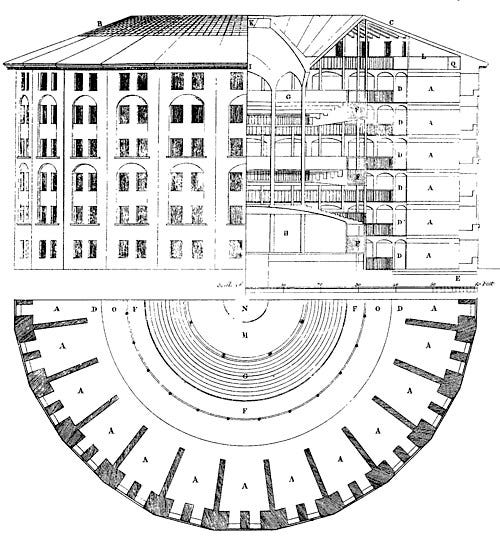
Therefore, Bentham believed, the uncertainty of always being watchable while never knowing if one is being watched would incentivize prisoners to regulate their own behaviors and ultimately improve themselves. This plan was meant to control and shape the minds of prisoners rather than just retaining physical control over their bodies. In Bentham’s mind, such a system embodied his progressive ideals for social reform — he genuinely hoped that the panopticon would allow prisoners to improve their behavior on their own without being subject to the harsh violence of traditional prisons.
While some people might have heard of the panopticon or have even witnessed the construction of similar prisons, there are a few parts of Bentham’s plan that aren’t brought up as often. First, the prisoners in his imagined building weren’t just held to some standard of good behavior or kindness. Rather, the prisoners were also to be workers. The purpose of the watchtower was to keep the prisoners working at all times. Inmates would be assigned manual labor tasks, and they knew that if they stopped working they could be spotted and punished at any time. He imagined that the constant fear of punishment would cause prisoners to self-discipline themselves into completing their tasks.
Second, the scope of the panopticon went far beyond prisoners. Bentham hoped that the success of his prison model would demonstrate the benefits of constant surveillance. Such surveillance could be done in factories, schools, and in public spaces to prevent deviancy.
Flock and the New Surveillance
In 2017, American security manufacturer Flock Group Inc. began a business of selling surveillance. Whereas security cameras weren’t anything new, Flock innovated by creating a network of automated license plate readers (ALPR). Flock opened its doors to anyone who wanted to buy into their promise of safety and security — law enforcement agencies (at all levels), neighborhood associations, business owners, or anyone willing to pay could have Flock cameras installed. Recently, U.S. Border Patrol, Customers and Border Protection, and the Drug Enforcement Agency have started putting up similar ALPR cameras near highways by the border while disguising them as traffic cones or barrels.
In addition to their claim of scanning over 20 billion vehicles each month, Flock has pushed to increase their audio surveillance capacity. Flock has integrated “gunshot detection” microphones to listen for “human distress” (particularly trained to pick up human screams).
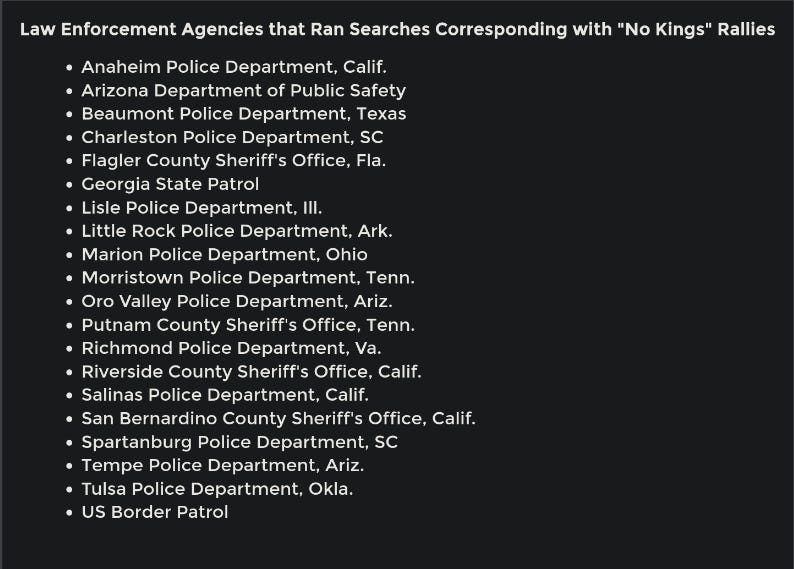
Police officers have used the data obtained through their Flock surveillance systems for what they do best: suppressing protesters (like the No Kings rallies), prosecuting activists (as with the animal rights activists at Direct Action Everywhere), and stalking their exes (this has happened multiple times).
Surveillance Camera Man
But you don’t need to be a corporation to surveil.
Some time in the early 2010s, an anonymous man in his 20s started posting videos in which he would walk around Seattle and simply point a camera at people. He wasn’t there to interview them, he wasn’t filming for a documentary — all he did was watch. He would walk into stores, restaurants, and classrooms as if nothing was wrong or out of the ordinary and just stand there, filming silently. Reactions vary from nervous laughter to violent threats, the one-way confrontations consist of a series of increasingly explicit outbursts and confused questioning.
We often tend to mentally dismiss cameras, audio recorders, and other forms of surveillance as long as we see ourselves as being in the public. We have areas of our lives (both physical and metaphorically) that we consider to be ours. We can share our private life if we wish, but no one else has privileged access to it. By defining a realm of our private life, we leave all other aspects of our lives public. We accept some level of loss of privacy when we enter the public — in a perfect world, all for some kind of common good: safety, happiness, and so on.
The reactions in the Surveillance Camera Man videos show how volatile and subjective the private/public distinction is. Regardless of if we’re on a sidewalk, in a public park, or inside a public establishment, we’re uncomfortable at the idea of someone filming us for no clear reason. Even in public, with all of the ways we voluntarily give up our privacy, the mere presence of a man with a camera pointed at us feels like an invasion of our personal lives.
While we might have social norms that hold up this distinction between private and public life, the relentless force of capital doesn’t see a difference. These lines are distorted not just as a result of drifting over time, but are now intentionally broken down in the pursuit of profit. In the workplace, we’re pressured into spending as many hours in the office as possible — our “work-life balance” can come from the ping pong table and an occasional day off. At home, the workplace isn’t gone. Instead, we’re expected to juggle unfinished tasks and urgent emails alongside our personal responsibilities. Even if we miraculously come up with some kind of free time, market pressures push us to make more money through a second job or “side hustle” or improve our employability through some form of training or education.
If our bodies and minds are already captured, our emotions aren’t safe either. Our mental health is largely defined by how well we can function within the existing social order. Our mental state, therefore, is only considered healthy insofar as it allows us to be perceived as a productive member of society. The GDP prefers a workaholic insomniac who can work all day and night over any other person who decides to devote any amount of time in their lives to their own interests, desires, and joys.
Bentham imagined prisoners never knowing if they were being watched. The mere fear of being caught deviating from protocol would prevent the need for actual punishment. Today, we know that we’re being watched and listened to 24/7, and we act in the same way. We police ourselves, avoiding social punishment by staying productive and within the narrow boundaries of what’s acceptable. We are the guard, the prisoner, and the structure in which they’re held.
Well written, fascinating essay, Nash. Sometime I would love to discuss this concept over a cup of coffee.