

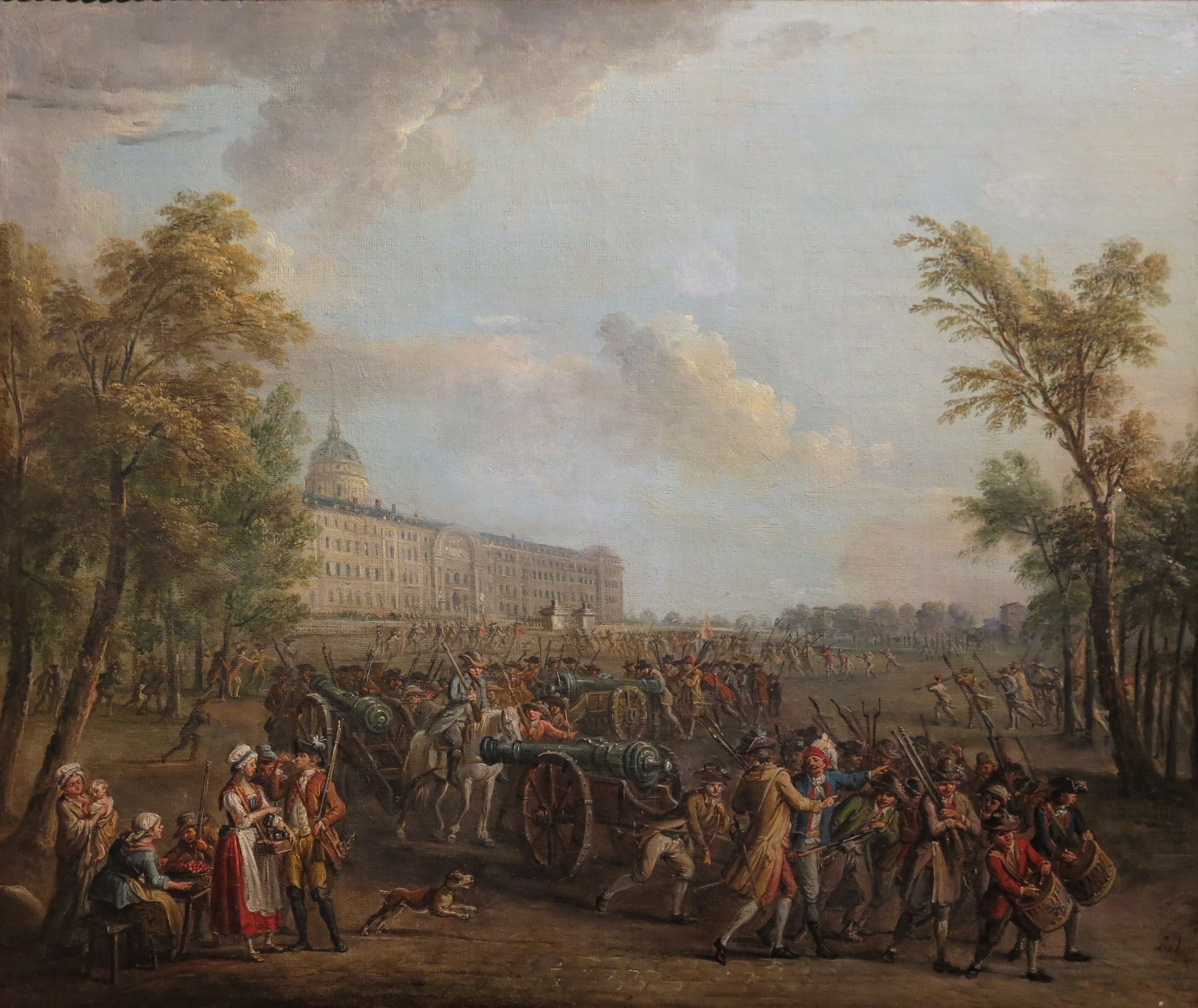
On the morning of July 14th, 1789, Louis Éthis de Corny led a march on the Hôtel de Ville (the city hall of Paris since 1357). Roughly eight thousand unarmed demonstrators grouped together in front of the building, where they were confronted by a physical obstacle: a giant ditch, twelve feet wide and eight feet deep. Not letting themselves be dissuaded, they solved this problem by jumping down into the ditch and then stacking on each other’s shoulders to reach the building entrance. Those who made it in seized twelve cannon parts and a mortar, and used those weapons to threaten the governor. On behalf of the city, they ordered that all weapons be handed over to the people. They left with 40,000 muskets in hand.
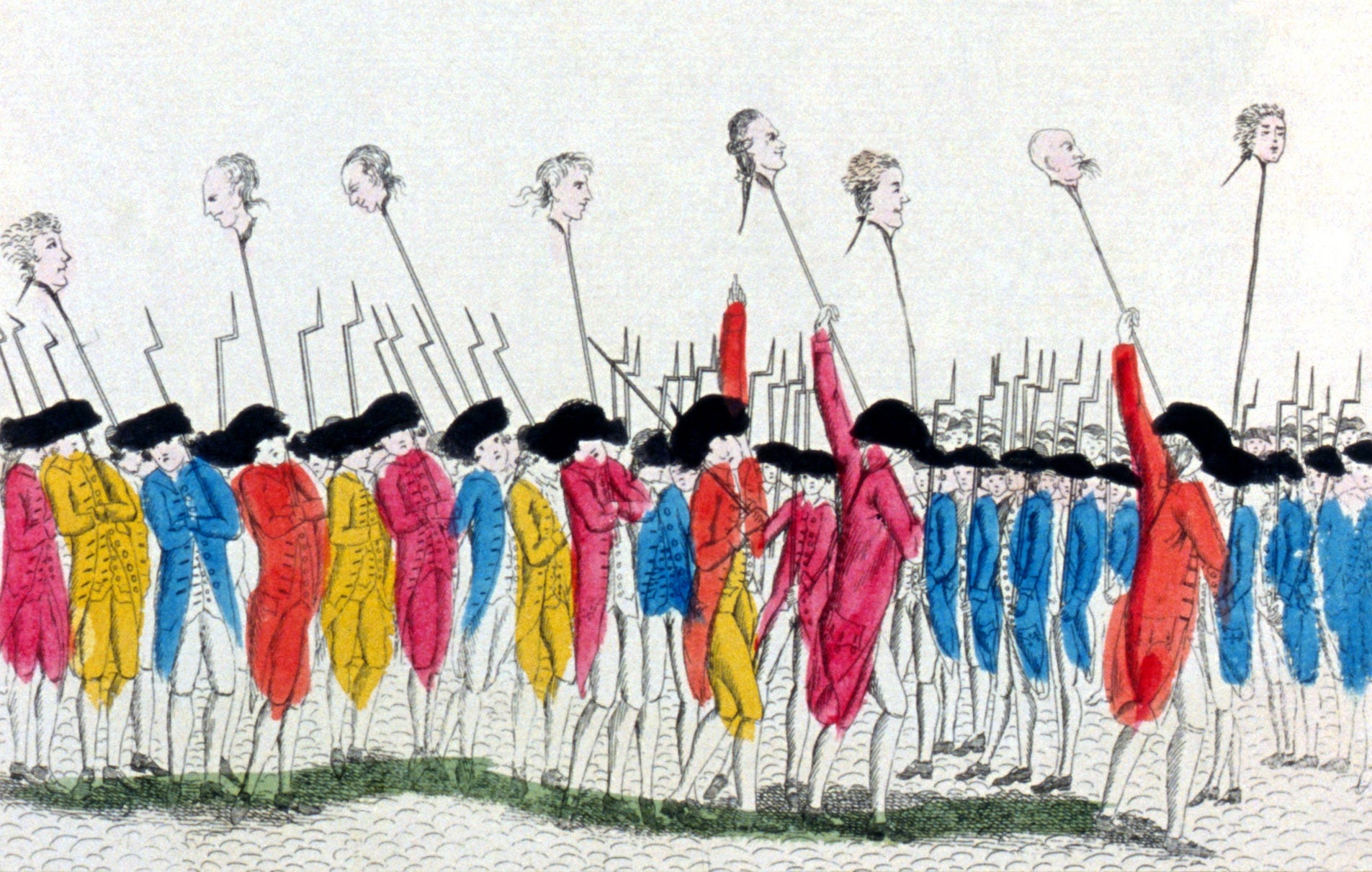
Simultaneously, various delegates made their way to the Bastille where they demanded all arms within the royal fortress be handed over to the people. Discussions intensified and no compromises were made. As people continued to gather in masses around the Bastille, tensions erupted when the royal garrison began to open fire on the representatives. Crowds took over the drawbridge and stormed into the courtyard, where guards continued to shoot at them from their towers. A cannon was brought over from the victorious assault on the city hall, which was promptly used to break down the gates. At around 5 P.M., the royal garrison and Swiss Guards surrendered to the people. The conflict ended with around one hundred deaths among the attackers, and one death among the guards. De Launay and Flesselles, who were believed to have initiated the shootings against the people, were decapitated and their heads paraded around the streets of Paris on tips of pikes.
The storming of the Bastille is the most famous event of the French Revolution. It marks a point commonly seen as the culmination of the efforts of the people, striking a decisive blow against the royalist institutions. Some people have even spoken of the storming as if it was the final chapter of the revolution in its purist form; the point before a just revolution devolved into pointless violence and chaos. This viewpoint, however, misses the broader historical arc at play. For while a triumphant victory against a near-holy symbol of the monarchy makes for a satisfying story, the storming of the Bastille was just the symbolic tip of the revolutionary iceberg. The taxes, feudal rights, and class structures of the royal regime were still in place — peasants and workers were still starving in the streets. The revolution has only just begun.
The Great Fear
News of the capture of the Bastille struck fear in the hearts of royal authorities across France. People in urban centers began to organize militias to maintain order and property as riots broke out demanding the end of taxation on wheat and bread. In Paris, Foulon, the controller-general, and his son-in-law Berthier were on their way to the Abbaye prison to await a trial. A crowd of demonstrators intercepted Foulon’s transportation, proceeding to hang him from a lamppost. Upon his death, they celebrated by cutting off his head, stuffing the mouth with hay, and parading it through the streets on the tip of a pike. Berthier fell to a similar fate, being captured by a crowd and killed with a sabre. The fears among nobles brought about by these events was just one side of the story, however. For the greater population of France had their imaginations captured by what came to be known as the Great Fear.
This Great Fear consisted of multiple intersecting beliefs. First, there was a belief that aristocrats were secretly conspiring with foreign powers to call in hordes of troops against the French people. Second, there was fear of a violence from within: reports of poor beggars, drifters, and brigands violently demanding food from farmers throughout the countryside. By late July, it was clear that both of these rumors were mostly unfounded conjecture. While they might not have been real at the time, the Great Fear had a powerful effect in the way that it primed people’s minds to stay vigilant against foreign plotting and internal bloodshed.
Taking advantage of the general disorder of the time, groups of impoverished peasants then began to storm the residences of feudal lords. They would demand access to the archival documents that granted feudal rights to the lords, at which point they would throw all of those documents into a bonfire. If a lord refused to cooperate, they achieved the same ends by turning the entire château building into the bonfire. In the Mâconnais, a peasant rebellion burned down over seventy châteaux — the feudal powers reacted by killing twenty of the peasants and imprisoning sixty more.
Noble Concessions
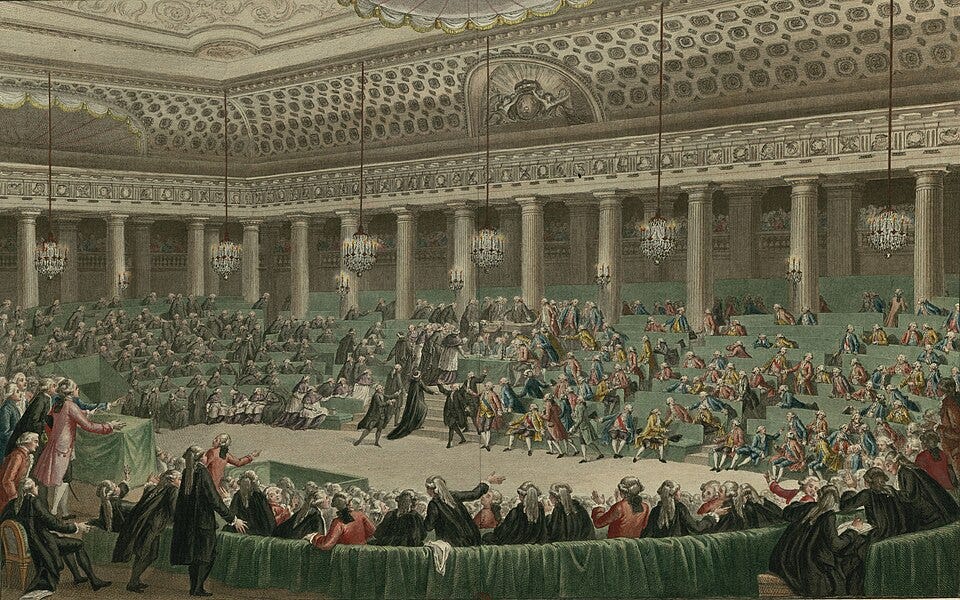
Members of the nobility realized that they would be forced to make political concessions in order to save their own lives. The most visible privileges of the existing order were to be destroyed: seigniorial rights, clergy’s tithing, and bourgeois purchases of public offices. The National Assembly followed suit by adopting similar ideas. In the opening line of their declaration on August 4th:
“The National Assembly destroys the feudal system in its entirety.”
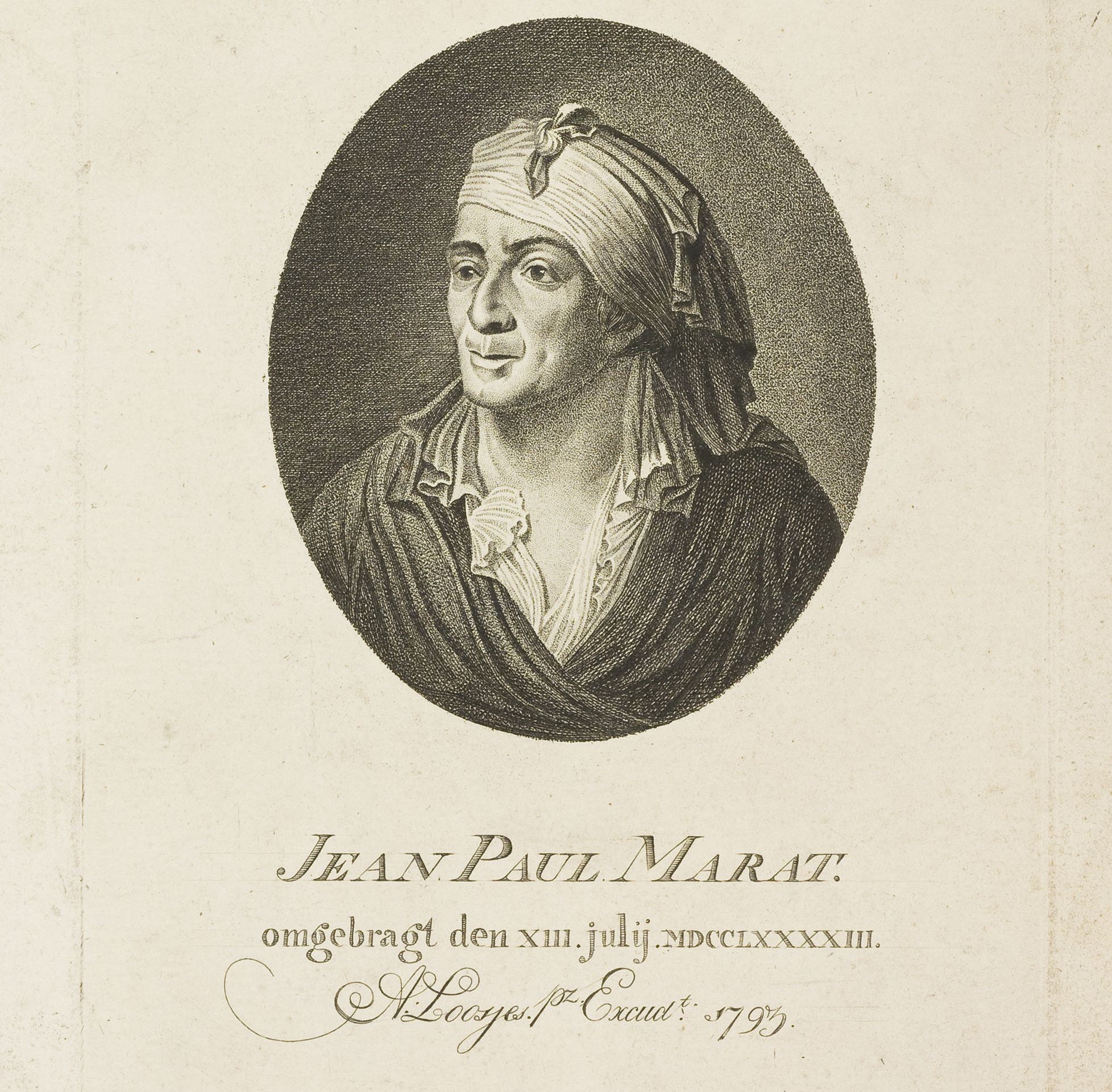
News of these concessions reached the people, and joyous celebrations flooded the streets of Paris. Not all of the people of Third Estate were convinced, however. In August of 1789, a relatively unknown man was busy at work writing the first issue of a new newspaper, L’Ami du peuple (The Friend of the People). He searched throughout town for a printer who was willing to publish his article on the Assembly’s actions:
“Let us beware; they are seeking to lull us to sleep, to deceive us. The truth is that the faction of aristocrats has always dominated the National Assembly, and the deputies of the people have always blindly followed the directions it has given them.”
This man’s name was Jean-Paul Marat, and no one could have predicted the effect that his contributions would have on the revolution for years to come. His warnings were timely, as peasants began to realize that their demands were still being largely ignored. Despite the formal appearance of an abolition of feudal power, bailiffs continued to demand the payments of the same taxes and rights that led to this situation: champarts, terrages, cens, lods, and feudal tithes. In many places, peasants were forced to band together in order to collectively refuse the payments of these dues. Marat’s message was a haunting omen for the violence that would come to follow this illusory moment of peace.
The Declaration of Rights
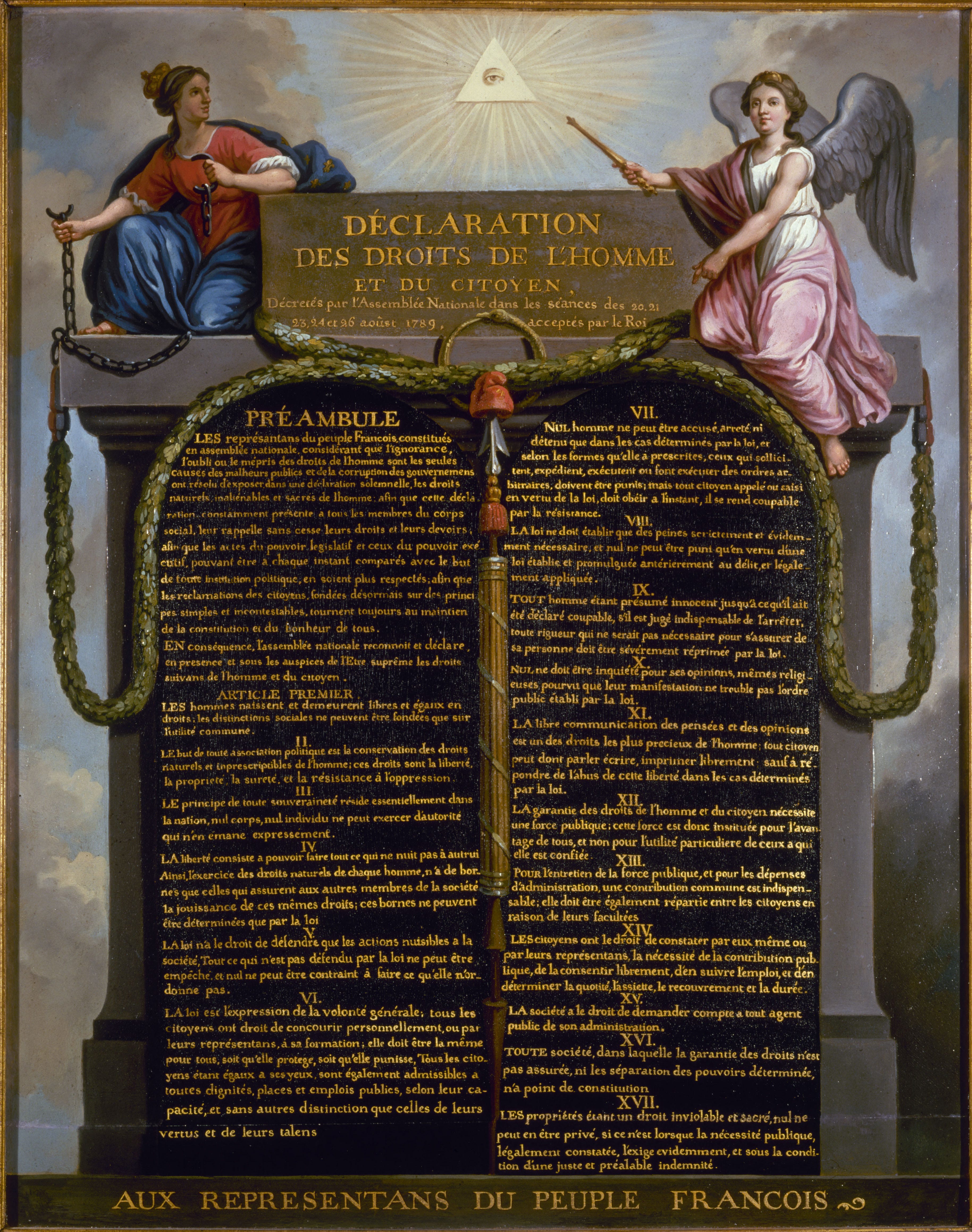
At this point, the Declaration of Rights was in its early stages of development. Whereas we might imagine the writing of such an important document as a deliberate, slow process, the reality of its conception was characterized by contradiction and disorder. In the National Assembly’s final session on August 26th, amendments and edits were thrown around amid individual conversations and arguments. Some rights that we would expect to be central were completely missing: a right to education, a right to assembly, and a right to petition. Rather than a coherent statement, the ‘final’ product of these talks was just a snapshot of this specific period in time.
Despite these contradictions, the social power of the Declaration was undeniable. Marking the end of the royal Ancien Régime, the beliefs that sovereignty belonged to the Nation rather than the king, that the law ought to express the general will of the people, and that all citizens ought to be afforded equal access to public offices, were fundamentally revolutionary. More than just policy reforms, the people had officially expressed their desires for the end of the divine rights of kings and the beginning of the natural rights of man.
The Women’s March on Versailles
The background of an economic crisis, the Great Fear, and distrust of the aristocracy brought tensions to some of their highest levels yet. In contrast to the more well-known storming of the Bastille, the next revolutionary spark was relatively unexpected.
On October 1st of 1789, a grand dinner was held at Versailles’ hall of the Opéra to celebrate the arrival of a new royal military regiment. The king, Louis XVI, and queen, Marie Antoinette, attended the dinner to greet their guests with wine and music. In return, the soldiers thanked them with supportive cheers. Later in the evening, the soldiers tore off their tricolor ribbons (representing the French nation) from their caps, replacing them with white ribbons in support of the king. Some of the officers even chose to replace their ribbons with black ones, a color representing support for the queen. The customary welcoming dinner had been turned into an overtly counter-revolutionary demonstration.
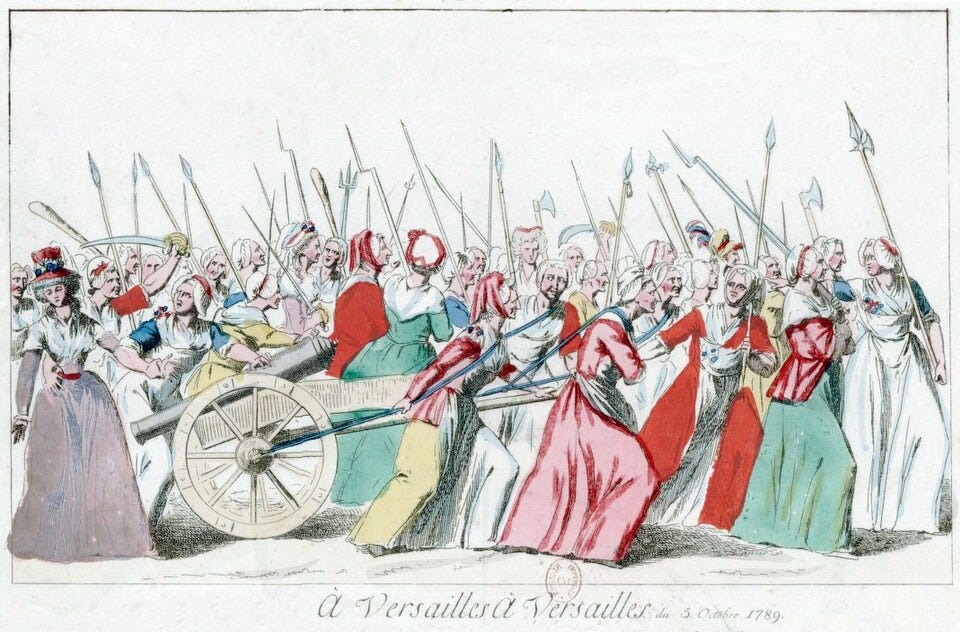
News of the counter-revolutionary dinner reached Paris on October 3rd, where a large group of women were already protesting against rising bread prices and troop movements. These women, overwhelmingly from the poorer classes, were largely anonymous. Yet their actions spoke as loud as their words, sending a shock throughout France. As historian Eric Hazan puts it:
“In the morning, groups of angry women gathered in Paris, around the Halles and in the faubourg Saint-Antoine. They then converged outside the Hôtel de Ville, where they screamed for bread. Not getting an answer, they overwhelmed the guard, forced the doors and entered the building, making off with pikes, muskets, and four cannon. Then, taking one of the heroes of the Bastille, Stanislas Maillard, as their captain, they formed a procession and set off for Versailles. Towards five o’clock in the afternoon, there was a crowd of six or seven thousand women outside the palace railings, joined by workers and gardes-françaises whom they met along the way.”
The women continued by sending a delegation to the National Assembly, with Stanislas Maillard as their spokesperson. There, they declared their two demands of Versailles: bread, and punishments for the royal guards at the royal dinner. The Assembly agreed, sending their president, Mounier, along with a small group of deputies to confront King Louis XVI. There, they presented their formal request:
“The pure and simple acceptance of the Declaration of Rights, and the full force of the executive power to provide the capital with the grain and flour that it needs.”
Louis XVI met with his council, where they suggested that he should flee to Rouen rather than meet the demands of the Assembly. He chose to decline the monarchists’ suggestion, and formally validated the Assembly’s demands at 10 P.M.
Two hours later, Lafayette arrived in Versailles. Right behind him, 15,000 men of the Paris National Guard were at his command. The night passed quietly, but demonstrations broke out among the people once again on the morning of October 6th. As crowds continued to gather, a new slogan formed and began to spread: ‘The king to Paris!’
One group found a way into the royal palace through a poorly guarded gate and broke into the Marble Court. One guard there fired at the crowd, killing a man, so the crowds threw themselves at the entire group of guards. They managed to kill two of the guards, giving them access to the royal apartments. As you might expect, they decapitated both of the slain guards and paraded their heads through the streets on the tips of pikes.
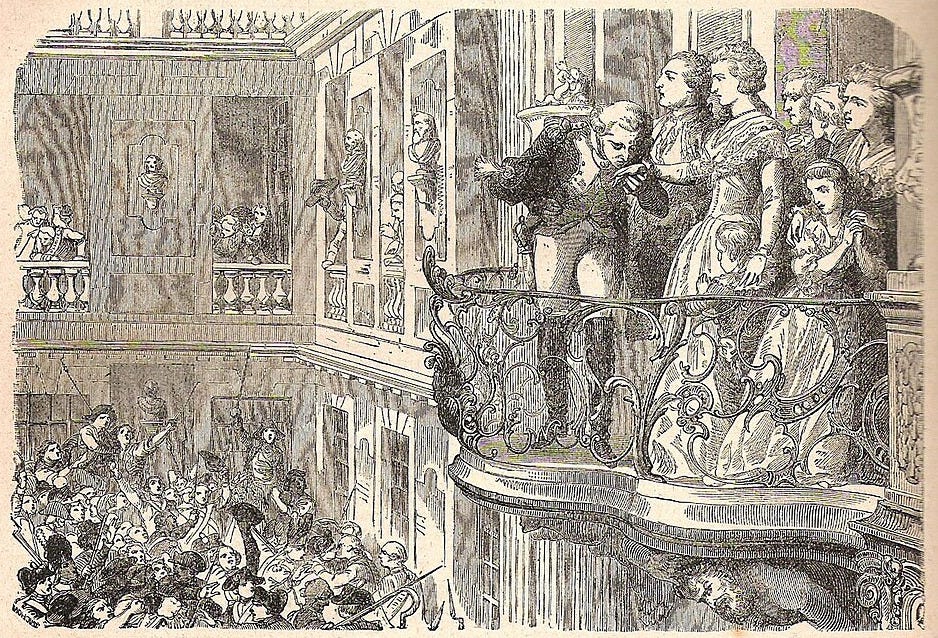
The crowd almost made it all the way to the queen’s bedroom, where Lafayette and the National Guard managed to hold them at bay. After clearing out the building, Lafayette and Louis XVI went out on the balcony to address the people. The queen, Marie Antoinette, and her children followed, but the crowds booed them away. Lafayette convinced the queen to come back out, at which point he decided to use his popularity to save her. He bowed deeply, kissing her hand, prompting applause from the audience. The royal family then gave into the demands of the people.
At 1 P.M., a grand procession left Versailles in order to bring the king to Paris. The National Guard led with loafs of bread on their bayonets and carried carts full of flour. The gardes soldés protected the royal bodyguards, who in turn protected the king and queen. The Flanders Regiment, the Swiss Guard, and Lafayette followed close behind them. At the end of the procession were the masses of the people, where women carried poplar branches as an icon of the French nation. At 10 P.M., the king and royal family arrived at their new home in Paris: the Tuileries palace.
Thanks for reading! This is part 2 in a series on the French Revolution. If you enjoyed it, you can support my work by liking this post, sharing it, or leaving a comment. If you didn’t enjoy it, feel free to tell me I’m wrong in the comments.
Part 1:

Main source: A People’s History of the French Revolution by Eric Hazan.
Looking back on some of the pivotal shifts in power and social relations in history can give us a better understand of the situation we find ourselves in today, and where we might try to go in the future. In the following posts, I hope to answer the following questions:
What reasons, if any, did people have for turning to revolution over any other methods of political change?
What caused ordinary people to support political violence, such as direct action against the state or the infamous September Massacres?
How should we think of the French Revolution today? Should we embrace the values of the revolutionaries of that era, or do we need to consider a new approach?