


1. The Dutch Dilemma
In the 1970s, a combination of oil embargoes and broadly increasing energy costs led to a widespread energy crisis across the Western world. People were forced to accept this new reality, meaning that they would have to start paying closer attention to how much energy their households were using. One particular suburb in the outskirts of Amsterdam ran into a perplexing issue. Even though all of the houses in the area were built at the same time, with the same structure and the same materials, they noticed that some households were using one-third less electricity without needing to change their own personal behaviors. All of the households got their energy from one provider that charged identical prices, and the families living in them were relatively similar. No one could come up with an explanation for this sharp divide between high-electricity and low-electricity households.
The true difference came down to one small quirk of the construction process: some houses had electric meters displayed in the front hall, whereas others had their meters displayed in the basement. The low-electricity households turned out to be the ones with meters in their front halls. Because the meter was in a spot that people had to walk past constantly, the members of these households saw the meter ticking up all day. In contrast, the households with meters in their basements rarely saw the information that could’ve reminded them about their electricity bills1.
2. One More Lane Will Solve Everything!
In the urbanized world, almost nothing can compare to the rage induced by the highway traffic of rush hour. No one likes being stuck in traffic, so we naturally look to an obvious solution: add another lane. If our roads are congested, then we can reduce that congestion by creating more space for cars to pass each other.
For an example of this fix, we can look to none other than the glorious Katy Freeway in the common-sense state of Texas, USA. In 2008 they decided to go big: who needs ‘just one more lane’ when you can instead have 26 of them? As we all know, this solution permanently fixed their traffic problems and Texans no longer need to sit stuck in traffic for hours. Right?
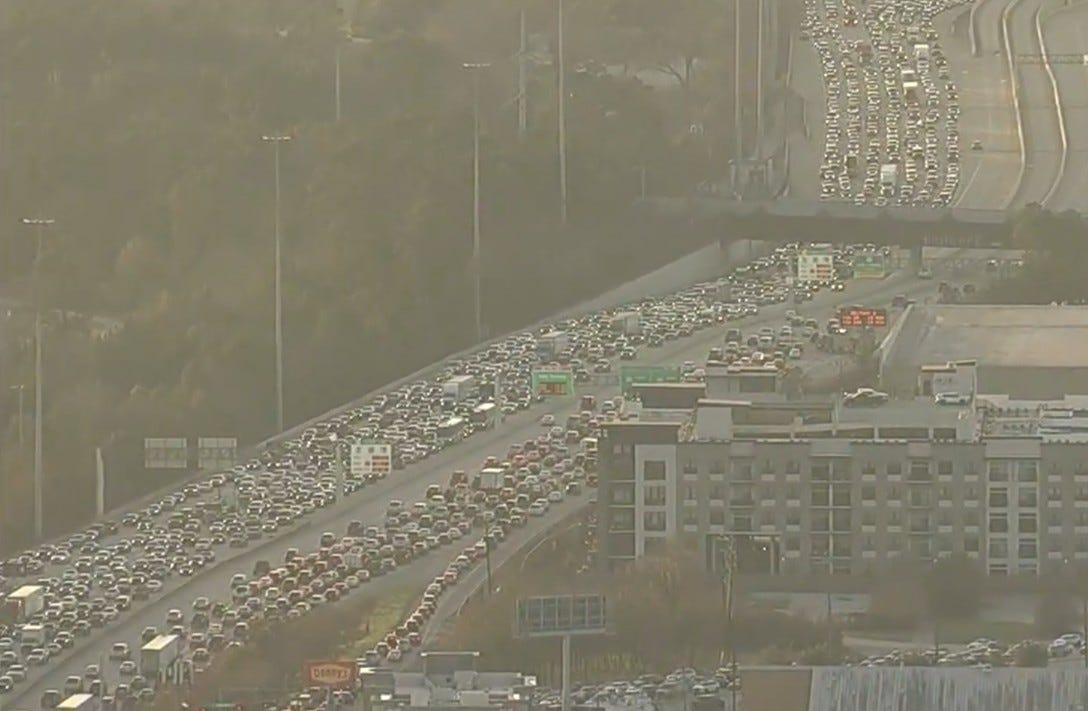
As it turns out, having 26 lanes doesn’t actually solve anything. Traffic jams continue to haunt these drivers just as much as anywhere else. But it’s not like anyone involved in this process is consciously choosing to make traffic worse. Individual drivers obviously don’t want this to happen, and if anything city planners are trying their best to fix it. Everyone agrees that there’s a problem here — so why is it that our so-called solutions seem to always make things worse? How is it that rational people with good intentions can produce outcomes that benefit no one?
Despite our best intentions, we see this pattern everywhere in our lives. Everyone sees the same problem, everyone agrees to implement a solution, yet the same old problems continue to persist while the problem-solution-problem cycle continues for generations. In fact, one of the great frustrations of politics is that it often seems like our most persistent issues only exist because of the failed fixes of the past. Shop inventories and prices swing wildly in response to steady demand, once-stable systems seem to collapse out of nowhere, and major pieces of legislation don’t have any effects until years down the line. We blame bad luck, disruptive events, and incompetent bureaucrats, yet dealing with these individual elements is almost never enough.
The problems aren’t the fault of bad people, bad luck, and bad actions. The true culprit is the hidden architecture of systems — the relationships between parts within systems that amplify or dampen change over time. Understanding this architecture is the difference between lasting solutions and billion-dollar highways that make traffic worse.
3. The Structure of a System
The Three Parts
Not every group of things is necessarily a system. In Thinking in Systems, Donella Meadows defines a system as “an interconnected set of elements that is coherently organized in a way that achieves something.” We can see that the parts of every system must consist of three things: elements, interconnections, and functions2.
Elements are the visible parts of a system — trees in a forest, or cars on a highway, or even intangible things like the collective pride of a nation. Although they’re often the easiest parts to spot, they’re usually the least important. Interconnections are the relationships that connect the elements, and are oftentimes built on a flow of information. The students in a school are interconnected by social rules, rumors on social media, and the knowledge they share with each other. A system will tend not to change even if you completely replace all of the elements. The individual cells in a human body are constantly replaced, yet the interconnections keep the system intact.
Functions are often the most important part of a system, yet they’re also the hardest to spot. Almost every system has a function of ensuring its own survival and continuation into the future. Functions don’t have to be intentional — in fact, they can directly contradict the goals set out by a system’s creator. The example of Texas’ Katy Highway shows us that the functions of human-made systems aren’t necessarily as obvious as we would like them to be. As Meadows puts it:
“A system’s function or purpose is not necessarily spoken, written, or expressed explicitly, except through the operation of the system. The best way to deduce the system’s purpose is to watch for a while to see how the system behaves.”
Stocks and Flows
Stocks are a specific type of element within a system. Meadows defines stocks as “the elements of the system that you can see, feel, count, or measure at any given time.” A stock can be physical (oil in a tank, items in a store), but they don’t have to be (your reserves of motivation or your self-confidence). Flows are interconnections that act to change the levels of a stock over time, whether it causes that stock to rise or fall. Because of this, a stock can act as a “present memory of the history of changing flows within the system.” We can measure these flows by keeping track of how various stock levels change over time.
Stocks can oftentimes take a long time to change because flows take time. You can’t drain a full bathtub instantly — the time it takes is dictated by how fast the water can flow down the drain. Although this can be detrimental, stocks can be harnessed in a positive way by intentionally using them as delays, buffers, and stabilizers. For example, a large stock of saved-up money can make a sudden emergency expense much less harmful.
“Systems thinkers see the world as a collection of stocks along with the mechanisms for regulating the levels in the stocks by manipulating flows.”
Feedback Loops
A feedback loop occurs when a stock affects the flows into or out of itself. These structures are oftentimes behind the appearances of sudden spikes or falls in a stock, but they also keep stocks within a certain range despite efforts to the contrary. We can broadly categorize feedback loops into two types: balancing and reinforcing.
Balancing feedback loops counteract change by pushing a stock in the opposite direction of any external force. The thermostat is a classic example: when the temperature drops below the setpoint, heating turns on; when it rises above, heating turns off. When we add highway lanes, congestion initially drops — but the balancing loop brings more drivers onto the road until traffic returns to its previous gridlock. This is why reshaping a system’s structure matters more than pushing harder against it — balancing loops will simply absorb whatever force we throw at it.
Reinforcing feedback loops are the opposite: they amplify change rather than counteracting it. Consider compound interest: the more money in your account, the more interest you earn, which increases your balance, which earns even more interest. The rich get richer through the same mechanism that causes spiraling debt, bank runs, and melting ice caps.
Once you start to recognize both types of feedback loops your understanding of systems can be greatly enhanced. As Meadows puts it: “instead of seeing only how A causes B, you’ll begin to wonder how B may also influence A — and how A might reinforce or reverse itself.” Furthermore, multiple feedback loops can intersect and influence each other. When one feedback loop starts to have a stronger impact on the behavior of a system than another, we can describe that change as shifting dominance. Systems can change radically and rapidly once the dominance is shifted — whether those shifts result in prosperity or crisis depend on the system’s structure prior to those changes.
4. Tricks, Traps, and Tragedies
The interactions of all of the various feedback loops we find in systems can oftentimes lead us to fall into the same pitfalls over and over again. Even when we’re in seemingly distinct scenarios, there are certain structures that tend to give us trouble. There are many such traps, but here we can look at some of the most common and destructive ones.
The first structure we see is known as the tragedy of the commons. Although this problem is oftentimes framed in terms of individual greedy people, a systems lens can show us that this occurs due to rational and predictable behaviors. This trap occurs when there’s a commonly shared resource that individuals can benefit from while spreading the consequences out among everyone. For example, overfishing can occur when individual people or entities don’t see a significant consequence for extracting fish from a body of water faster than the rate at which the fish can repopulate. This results in an overuse of the shared stock until eventually the entire stock is depleted and no one can benefit from it anymore. The way out of this situation is to reduce the delay of feedback and increase the severity of punishments for taking more than one’s fair share.
The second structure is known as shifting the burden to the intervenor. This trap can also be characterized as dependence or addiction depending on the situation. This occurs when a solution is implemented to reduce the symptoms of a problem without actually addressing the underlying systemic issues. Over time, more and more of the so-called solution is needed to preserve the appearance of a fixed system. A great example of this can be found in the actions of 1950s logging companies. In parts of North America, loggers noticed that budworms were destroying valuable spruce and fir trees and therefore cutting into company profits. To combat this, they started to spray insecticides to kill those budworms. While this gave the illusion of solving the problem, the insecticides had the unintended effect of killing the natural predators of the budworm — birds, spiders, parasitic wasps, and diseases. This weakened the balancing feedback loop that kept budworms alive without letting them take over the entire forest. With no more natural predators left, the logging companies were forced to spray ever-increasing amounts of insecticides to take over the gap left by the disappearing predators. The way to escape this trap is to understand and enhance a system’s capacity to address problems on its own.
The third structure is known as the drift to low performance. This happens when we let our performance goals be influenced by our past performances. Especially in cases where there’s a negative bias in perceptions of the past, the perceived worsening of performances leads to a lowering of standards, which then leads to further declines. We often see these lowering standards expressed through comments like “this is how it’s always been” or “that’s just how things are.” Even though each small decline in performance standards seems completely reasonable, the slow erosion over time results in a reinforcing feedback loop that pushes us towards the worst possible outcomes. To solve this issue, we can keep our performance standards independent from our outcomes. Alternatively, we can set our goals based on our best historical performances rather than our worst ones.
The commonality between these three traps are that feedback loops lead to important information being missing, delayed, or distorted. In order to avoid the undesirable outcomes associated with these structures, the solutions we implement have to be focused on changing the structures underlying our systems rather than just shifting around individual elements within those systems. We can’t fix these problems by throwing more and more ‘common-sense’ solutions at the symptoms — we need to examine and reshape the underlying structures.
5. A Double-Edged Dance
Why is it that something as simple as an electric meter’s location (hallway versus basement) can produce substantial energy savings, yet a project as ambitious as a 26-lane highway can spend billions of dollars while just making a problem worse? The meter placement changed the information flow in the system—residents could see their electricity consumption in real time, creating a balancing feedback loop where high usage triggered immediate awareness and behavior adjustments. The highway solution ignored feedback entirely. Planners assumed static demand, missing the reinforcing loop where new lanes reduce travel time and attract nearby development, which attracts more drivers to fill the lanes. Accidental architectural choices can reshape behavior more effectively than billion-dollar projects — when one works with the system’s feedback structure and the other fights against it.
This pattern repeats everywhere once you start looking for it. We blame incompetent bureaucrats for policy failures, greedy individuals for tragedies of the commons, or bad luck for economic crashes—when the real culprit is often the feedback structure itself. A traffic jam isn’t caused by too many individual drivers; it’s caused by the reinforcing loop between road capacity and demand. Poverty isn’t caused by individual poor choices; it’s maintained by balancing loops that resist intervention.
When we try to rationally solve problems, we often get stuck in a linear mindset: find a cause and effect, then manipulate the cause to change the effect. Rather than asking ‘who’s to blame?’ or ‘what single fix will work?’, we need to ask different questions: What feedback structures are at play? What information is missing, delayed, or distorted? Which loops amplify harm, and which promote wellbeing? This shift in thinking becomes ever more important as we tackle climate change, global health, and wealth inequality—problems that resist simple solutions precisely because they’re systemic.
As Donella Meadows puts it:
“We can’t impose our will on a system. We can listen to what the system tells us, and discover how its properties and our values can work together to bring forth something much better than could ever be produced by our will alone. We can’t control systems or figure them out. But we can dance with them!”
This example is provided Thinking in Systems, pg. 109. It’s just an anecdote, so we don’t have the exact numbers or specifications.
The word purpose is sometimes used instead of function when describing human-made systems. To keep things simple, I’ll continue to use the term function regardless of which system we’re analyzing.
Just finished reading your post. Excellent writing about a fascinating and relevant topic. As a person who has always worked toward achieving social justice and positive community change, I see the value of sharing your post with all people who want to see real change in our world.